On Monday, U.S. President Donald Trump sent out official letters to several governments, including Japan, South Korea, and South Africa, informing them about new tariffs that will take effect on August 1. Meanwhile, Canada still has until July 21 to agree with the U.S. before facing similar trade penalties
U.S. President Donald Trump has announced fresh tariffs on imports from several countries, launching a new wave in his ongoing global trade offensive. While nations like Japan, South Korea, and Indonesia face steep hikes starting August 1, Canada has, for now, escaped further penalties.
On Monday, Trump issued formal notices to 14 nations, revealing specific tariff rates on their exports to the United States. Countries such as Serbia, Thailand, and Tunisia are included in the list, alongside economic powerhouses Japan and South Korea. The decision follows months of escalating trade moves since Trump’s return to office earlier this year.
Japan and South Korea will face a 25% tariff beginning next month. In a bold message shared on Trump’s Truth Social platform, he warned that any retaliatory moves from these nations would result in even higher tariffs. "Whatever percent you raise, we'll add that to our 25%," he wrote.
The tariffs will not stack with earlier ones already placed on cars, aluminum, or steel. Additional tariffs have been laid out in a detailed breakdown:
- 25% in Tunisia, Malaysia, Kazakhstan
- 30% in South Africa, Bosnia
- 32% in Indonesia
- 35% in Bangladesh, Serbia
- 36% in Cambodia, Thailand
- 40% in Laos, Myanmar
South Korea will retain the tariff level first introduced in April, dubbed “Liberation Day” by Trump. Japan’s rate is slightly higher than what was initially suggested.
Despite tough stances, Trump left the door open for negotiation. Agreements have been reached with only two nations so far — the U.K. and Vietnam. Countries are rushing to beat the August 1 deadline. South Korea has vowed to ramp up negotiations with Washington, aiming to protect shared industries through what it calls a “renaissance partnership.” Japan has received a U.S. proposal to continue talks and hopes to strike a fair bilateral trade deal.
In a move that gives some countries more breathing room, Trump delayed the earlier July 9 tariff deadline to August 1, saying some deals were "close."
Markets React Swiftly
The financial world responded with caution. U.S. stock markets dipped, with the S&P 500 falling nearly 1% — its biggest drop in weeks. Shares in Japanese auto giants like Toyota and Honda also slid, and the U.S. dollar strengthened against the yen and won.
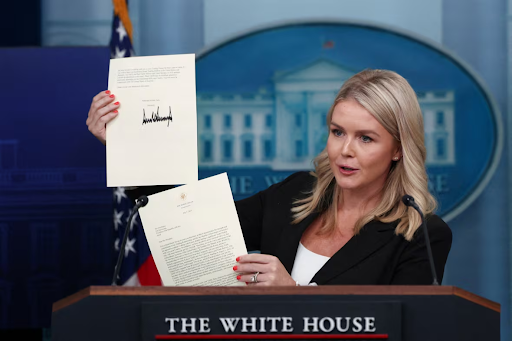
White House press secretary Karoline Leavitt displays a letter signed by President Donald Trump regarding tariffs, addressed to South Korean President Lee Jae Myung, during a Monday briefing in Washington. (Evelyn Hockstein/Reuters)
U.S. Treasury Secretary Scott Bessent hinted more deals could be announced soon, mentioning that his inbox was overflowing with last-minute offers. “It’s going to be a busy few days,” he said.
Canada’s Quiet Corner
Canada, however, has largely been spared — at least for now. No new tariffs were placed on Canadian goods on April 2, unlike other nations. A separate deal between Canadian Prime Minister Mark Carney and Trump, focused on security and economic matters, remains in progress. The two leaders have set July 21 as their deadline.
Still, Canada faces existing U.S. tariffs on cars, aluminum, and steel, as well as separate fentanyl-related trade penalties. Even without being directly targeted, Canada could feel the ripple effects if global trade is disrupted.
European Union Still in Talks
The EU hasn't received a letter from the White House about new tariffs yet. However, negotiations continue. The EU hopes to reach a deal before the July 9 deadline. That may prove urgent, as Trump recently floated the idea of slapping a 17% tariff on European food and agricultural exports.
Additionally, Trump has set his sights on BRICS nations, threatening a 10% tariff on members aligning with "anti-American" positions. This group includes Brazil, Russia, India, China, and South Africa — plus newer additions like Iran and the UAE.
As Trump’s deadline nears, countries are scrambling to strike last-minute deals. The stakes are high, and the world is watching closely.