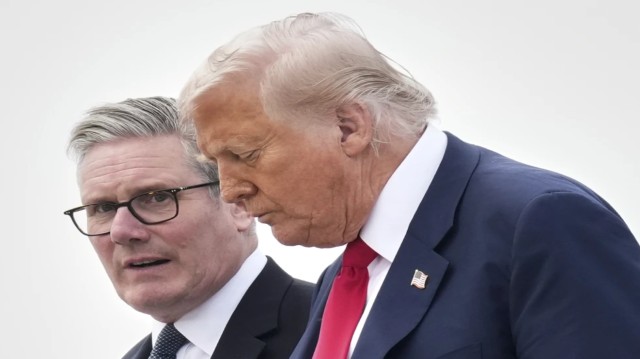
President Donald Trump and Britain’s Prime Minister Keir Starmer exit Air Force One as they arrive at Royal Air Force Lossiemouth en route to Aberdeen, Scotland Monday, July 28, 2025.
U.S. President Donald Trump has landed in the United Kingdom for a rare second state visit. The trip mixes royal pageantry with high-stakes diplomacy, as London and Washington eye new trade and technology partnerships.
The visit arrives at a sensitive time for both nations. While the U.S. and U.K. remain close allies, differences over Ukraine, the Middle East, and global trade policies continue to test the relationship. Still, officials on both sides insist the historic transatlantic bond remains firm.
Royal Welcome for Trump
Trump’s two-day stay features all the ceremonial grandeur Britain is famous for. Horse-drawn carriages, honor guards, and a lavish banquet inside Windsor Castle are planned. King Charles III will host Trump at the iconic royal residence before he meets Prime Minister Keir Starmer at Chequers, the prime minister’s countryside retreat.
Trump expressed excitement before the trip. “The visit is going to be incredible,” he told reporters, calling Windsor Castle “amazing” and “very exciting.”
Trump’s Historic Second State Visit
Trump is the first U.S. president ever to receive a second state visit to the U.K. The unprecedented honor appeals to his well-known love for royal traditions. He often praises the late Queen Elizabeth II and recalls his Scottish mother’s admiration for the monarchy.
The president has also leaned into grandeur at home. His Oval Office now features gold accents, and he has overseen new construction at the White House, including an opulent ballroom. Foreign leaders have taken note. On a recent Middle East trip, Saudi and Qatari officials even sent fighter jets to escort his plane.
Starmer’s Diplomatic Balancing Act
For Starmer, the visit offers both opportunities and risks. On one hand, it allows him to project statesmanship by securing closer ties with Washington. On the other hand, Trump’s unpopularity in Europe complicates the optics.
Starmer has already worked to charm the American leader. During a February trip to Washington, he praised Trump’s decision to display a bust of Winston Churchill. In July, he visited Trump’s Scottish golf courses, offering warm words.
Still, not all in Starmer’s Labour Party are comfortable with the approach. Unlike French President Emmanuel Macron, Trump will not address Parliament, partly because lawmakers are on recess — and partly to avoid controversy.
Political Troubles at Home
Starmer’s government is facing turbulence as the visit unfolds. Britain’s ambassador to Washington, Peter Mandelson, was dismissed last week over past ties to disgraced financier Jeffrey Epstein. Mandelson had strong connections with the Trump administration and played a key role in a May trade agreement. His sacking has reopened uncomfortable headlines.
This comes on top of Deputy Prime Minister Angela Rayner’s resignation over a tax issue. Fourteen months after a landslide victory, Starmer’s approval ratings are sliding. Yet Trump has offered unexpected support, describing Starmer as a “friend” — though “slightly more liberal.”
Trade and Technology at the Center
Despite political distractions, trade talks remain central to the visit. The U.S. is the U.K.’s largest trading partner, accounting for 18% of its exports. A deal signed in May reduced U.S. tariffs on Britain’s auto and aerospace sectors, but negotiations continue on steel, aluminum, and pharmaceuticals.
This week, Trump and Starmer are expected to sign a new technology partnership. The deal could bring major investments in artificial intelligence, nuclear energy, and life sciences. Tech leaders including Nvidia’s Jensen Huang and OpenAI’s Sam Altman are part of the U.S. delegation.
Analysts say the tech deal is crucial for Starmer, who needs to show progress on growth and productivity.
Ukraine and Global Disagreements
The leaders will also discuss foreign policy. Starmer has urged Trump to maintain support for Ukraine. But the president has so far avoided tough sanctions against Russia. He even downplayed a recent Russian drone strike in Poland, calling it “possibly a mistake.”
The two also differ on Israel and Gaza. Starmer plans to push for recognition of a Palestinian state at the UN, while Trump maintains a firmer pro-Israel stance.
Experts note that while Britain influences U.S. rhetoric on global issues, it has limited sway over Trump’s decisions.
A Visit of Symbolism and Strategy
For Trump, the visit delivers the royal spectacle he relishes. For Starmer, it is a chance to appear statesmanlike and secure economic wins. But with protests expected and divisions over Ukraine and the Middle East, the trip also underscores the challenges of managing one of the world’s most important alliances.