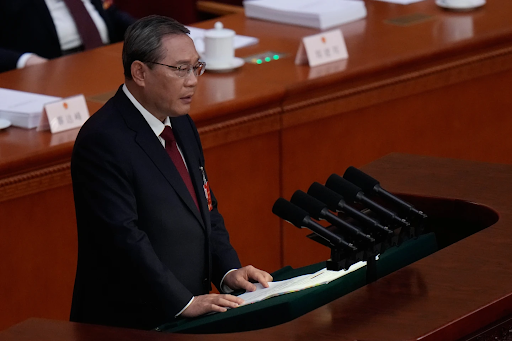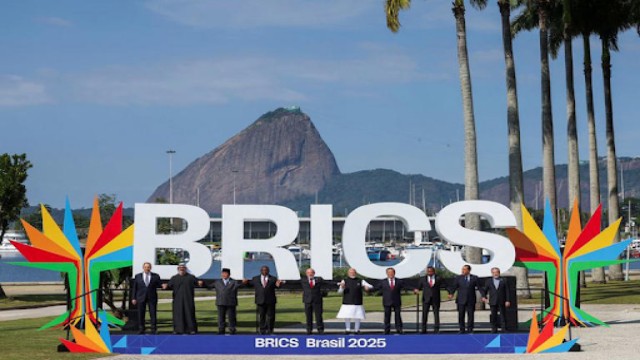
Leaders from Brazil, China, Russia, India, Indonesia, South Africa, Egypt, Ethiopia, the UAE, and Iran came together for a group photo during the BRICS Summit held in Rio de Janeiro on July 6, 2025. The summit brought top officials, including Brazil's President Lula da Silva, India’s Prime Minister Narendra Modi, and China's Premier Li Qiang.
Former U.S. President Donald Trump has threatened to impose an additional 10% tariff on any country that supports BRICS’ “Anti-American” agenda, just as BRICS leaders wrapped up a high-profile summit in Brazil. This move throws fresh uncertainty into global trade discussions, already under strain as the U.S. prepares to revise its tariffs policy in the coming days.
In a post on Truth Social Sunday night, Trump made his message clear: “Any Country aligning itself with the Anti-American policies of BRICS, will be charged an ADDITIONAL 10% Tariff. There will be no exceptions to this policy.”
While Trump did not clarify what he considers “anti-American,” his remarks followed closely after BRICS nations—Brazil, Russia, India, China, and South Africa—issued a joint statement condemning recent military actions by the U.S. and Israel in Iran and Gaza. The BRICS leaders also demanded that Israel withdraw troops from Gaza and called for an immediate ceasefire in the Middle East.
The timing of Trump's announcement appears strategic. The current 90-day hold on elevated tariffs is set to expire this Wednesday, and the U.S. is preparing to send out fresh tariff notifications starting Monday at noon. Countries that haven't finalized trade agreements with Washington are racing against time to either secure a deal or request a possible three-week extension.
“Trump’s comments are a warning shot for emerging markets leaning toward BRICS,” said Mingze Wu, a trader at StoneX Financial Inc., Singapore. “It likely reflects displeasure with BRICS’ stance on Gaza.”
At the Brazil summit, BRICS leaders spoke in one voice, denouncing military attacks on Iran and calling for peace in the Israeli-Palestinian conflict. They expressed deep concern over humanitarian aid blockades in Gaza and urged for an “unconditional ceasefire” and the release of hostages.
China’s Premier Li Qiang emphasized that BRICS nations should lead the charge in reforming global systems and promoting peaceful conflict resolution. “Unilateralism and protectionism are rising,” he said, underscoring China’s willingness to work with BRICS to build a fairer global order.
Despite Trump’s pointed rhetoric, most BRICS nations remained tight-lipped. China’s Foreign Ministry and India’s Commerce Department declined to comment. Indonesia’s Coordinating Ministry for Economic Affairs said discussions with the U.S. are ongoing and expressed hope for a positive outcome.
Trump has previously floated the idea of slapping 100% tariffs on BRICS nations if they ditch the U.S. dollar in their trade dealings. This has accelerated BRICS' efforts to develop their own cross-border payment system, reducing dependence on the dollar. Though this alternative system has been in talks for over a decade, Sunday’s summit saw renewed commitment to pushing it forward.
As the deadline for new U.S. tariffs looms, the world watches closely. Trump’s statements may signal a new chapter in global trade disputes, particularly for nations inching closer to the BRICS bloc.