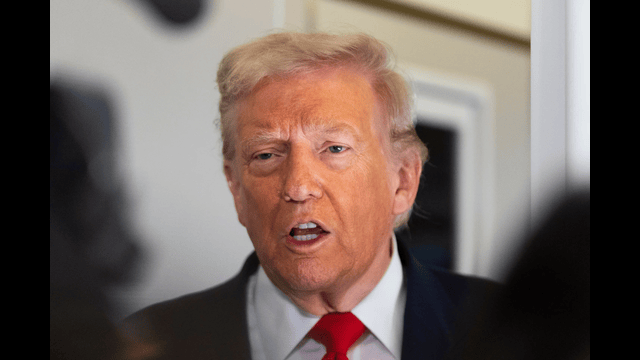
President Donald Trump speaks to the media after boarding airforce one at joint base.
U.S. President Donald Trump has stated that Chinese President Xi Jinping assured him that Beijing will not move toward unifying Taiwan with mainland China during Trump’s presidency.
During an interview with CBS’ “60 Minutes”, Trump revealed that although Taiwan wasn’t a major topic in his recent talks with Xi in South Korea, he is confident that China will refrain from taking any aggressive action on the issue while he remains in office.
“He has said, and his people have said at meetings, ‘We would never do anything while President Trump is president,’ because they know the consequences,” Trump told the network.
Talks Focused on Trade, Not Taiwan
Trump mentioned that his discussions with Xi mainly revolved around U.S.-China trade tensions rather than the Taiwan question. The meeting took place during Trump’s visit to South Korea, where the two leaders reportedly addressed economic cooperation and regional stability.
While Taiwan did not directly feature in their conversations, Trump reiterated his confidence that Beijing would avoid any steps that could destabilize the region or escalate military tensions.
The Taiwan Question and U.S. Policy
Taiwan remains one of the most sensitive issues in U.S.-China relations. China regards the self-ruled island as part of its territory and has long vowed eventual reunification, by force if necessary.
The United States, under the 1979 Taiwan Relations Act, does not formally recognize Taiwan as an independent nation but supports its right to self-defense. The law commits Washington to provide Taipei with military equipment and assistance to deter potential aggression from China.
However, it stops short of guaranteeing direct U.S. military intervention if China launches an attack.
Strategic Ambiguity Still in Play
When asked whether he would order U.S. troops to defend Taiwan in the event of a Chinese attack, Trump avoided a direct answer.
“You’ll find out if it happens,” he said. “And Xi understands the answer to that.”
This cautious response reflects America’s long-standing policy of strategic ambiguity, designed to deter both Beijing from using force and Taipei from declaring full independence.
Both Republican and Democratic administrations have followed this approach to maintain a delicate balance in the Taiwan Strait and avoid direct confrontation with China.
China Reaffirms Its Position
The Chinese Embassy in Washington declined to comment specifically on Trump’s claim of receiving personal assurances from Xi. However, embassy spokesman Liu Pengyu released a statement restating Beijing’s firm stance on the matter.
“The Taiwan question is China’s internal affair, and it is the core of China’s core interests,” Liu said. “No one will be allowed to separate Taiwan from China in any way.”
He further emphasized that resolving the Taiwan issue is a decision for the Chinese people alone, rejecting any form of foreign interference.
White House and CBS Stay Tight-Lipped
The White House has not confirmed when or how Xi Jinping conveyed the assurance to Trump. Officials also declined to elaborate on any diplomatic communications between the two leaders regarding Taiwan.
The “60 Minutes” interview, recorded at Trump’s Mar-a-Lago resort in Florida, marked his first appearance on the program since he settled a lawsuit earlier this year with CBS News over a previous interview involving Vice President Kamala Harris.
A Fragile Calm Amid Growing Tensions
Trump’s statement comes amid rising global concern over China’s military maneuvers near Taiwan and increased U.S. support for the island’s defense capabilities.
While Trump insists that Xi will maintain restraint during his term, the Taiwan issue remains one of the most volatile flashpoints in U.S.-China relations — a test of diplomacy that could define the balance of power in the Indo-Pacific.