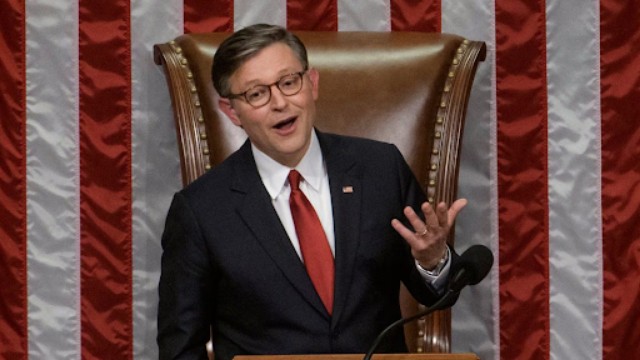
House Speaker Mike Johnson, a Republican from Louisiana, gets ready to lead the vote in the House chamber on President Donald Trump’s key bill involving tax cuts and reduced government spending, Thursday, July 3, 2025, at the Capitol in Washington. (AP Photo/Rod Lamkey, Jr.)
In a dramatic showdown on Capitol Hill, the U.S. House of Representatives has approved former President Donald Trump’s sweeping tax and spending overhaul — a massive $4.5 trillion package that’s now set to become law. The bill passed with a narrow 218-214 vote after days of political wrangling, floor drama, and last-minute negotiations.
Two Republicans broke ranks to oppose the legislation, while Democrats stood united against it. House GOP leaders worked tirelessly behind closed doors to rally support, and even Trump personally urged skeptics to fall in line. Meanwhile, Democratic leader Hakeem Jeffries took the House floor for nearly nine hours in protest — delivering a record-setting speech slamming the bill as harmful and unjust.
As Trump boarded Air Force One en route to Iowa, he declared, “This is going to be a great bill for the country.” He plans to sign it into law on Friday, just ahead of the July Fourth holiday.
Packed with Tax Breaks, Deep Cuts, and National Security Spending
This bill is a key win for Trump and the Republican Party. Nicknamed the “one big beautiful bill,” the nearly 900-page legislation is a cornerstone of Trump’s second-term agenda. It includes a range of tax breaks—some new, others extensions from his 2017 cuts.
Among the notable changes: workers can now deduct tips and overtime, and older adults earning less than $75,000 annually may qualify for a $6,000 tax deduction. The bill also promises $350 billion in defence spending, including funding for the proposed “Golden Dome” anti-missile system and tougher immigration enforcement.
However, to balance the tax giveaways, Republicans have slashed $1.2 trillion from Medicaid and food assistance programs. Work requirements for recipients will now include some parents and seniors, and key green energy incentives are being pulled back.
Costly for the Country and the Vulnerable, Critics Warn
According to the Congressional Budget Office, the bill is expected to add $3.3 trillion to the national deficit over the next decade. It also projects that over 11 million more Americans could lose their health coverage.
Democrats have fiercely opposed the bill, calling it a windfall for the rich that sacrifices the poor. Jeffries, in his marathon speech, called the legislation a “crime scene,” reading letters from Americans who rely on Medicaid and food aid.
“This bill puts the health, safety, and dignity of millions at risk,” he said.
Internal GOP Tensions and Pressure from Trump
Passing the bill wasn’t easy. Deep divisions within the GOP nearly derailed it multiple times. Conservatives wanted deeper cuts, while moderates worried about harsh impacts on their constituents. Ultimately, Trump’s pressure campaign—and the promise of federal perks for lawmakers’ districts—helped bring enough Republicans back into the fold.
Opposition was not without consequences. Sen. Thom Tillis of North Carolina, after opposing the bill, announced he won’t seek reelection. Rep. Thomas Massie of Kentucky, another Republican holdout, said bluntly, “It wasn’t beautiful enough for me to vote for it.”
A Sharp Turn from the Obama and Biden Eras
This bill marks a clear departure from past Democratic priorities. It chips away at Obama-era Medicaid expansion and walks back key climate change initiatives from Biden’s Inflation Reduction Act.
Republicans argue these changes are necessary. They say they’re focusing benefits on those most in need—pregnant women, the disabled, and children—while eliminating waste and fraud.
Still, analysis from the nonpartisan Tax Policy Center shows who benefits most. If the 2017 tax cuts had expired, the lowest earners would’ve seen a modest $150 tax break under this bill. Middle-class families would receive about $1,750. Meanwhile, the wealthiest would walk away with a $10,950 tax cut.