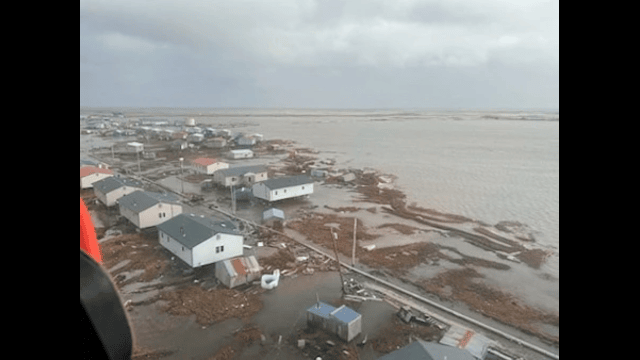
In this photo provided by the U.S. Coast Guard, Kipnuk, Alaska, experiences coastal flooding, Sunday, Oct. 12, 2025.
The remnants of Typhoon Halong have left a trail of destruction across remote Alaska Native villages, forcing officials to airlift evacuees and provide emergency shelter amid worsening weather and the fast-approaching winter.
Over the weekend, high winds and surging floodwaters battered the low-lying communities scattered across the Yukon-Kuskokwim Delta, about 500 miles from Anchorage. The aftermath has been catastrophic—homes washed away, entire villages cut off, and hundreds left homeless.
Race Against Time in Alaska’s Isolated Regions
Officials are scrambling to find shelter for more than 1,500 displaced residents as supplies run low and temperatures drop. The Coast Guard rescued around two dozen people after their homes drifted out to sea. Three people were reported missing or dead.
The National Guard Armory in Bethel, a regional hub of 6,000 residents, has become a key evacuation point. However, limited space and damaged infrastructure have prompted plans to relocate evacuees to Fairbanks and Anchorage for longer-term shelter.
Fuel storage facilities, crucial for heating and transport, were damaged in several areas. Officials fear potential fuel leaks could pollute rivers and harm fish populations, threatening the local subsistence lifestyle. Many residents also lost freezers stocked with salmon and moose, essential for surviving Alaska’s harsh winters.
“Catastrophic in Kipnuk” — Officials Describe Grim Reality
The worst damage hit Kipnuk (population 715) and Kwigillingok (population 380). Both are off-road villages, accessible only by air or water.
“It’s catastrophic in Kipnuk,” said Mark Roberts, incident commander with Alaska’s emergency management division. “We are doing everything we can to support that community, but it’s as bad as you can imagine.”
Residents described scenes of despair as they watched entire homes drift away under the moonlight.
Heartbreaking Scenes as Families Watch Homes Vanish
Among those waiting to be evacuated was Brea Paul from Kipnuk. She recalled watching 20 homes float away during the night.
“Some houses blinked their phone lights at us like they were asking for help,” she said in a text message. “But we couldn’t do anything.”
By morning, she captured video of a house submerged nearly to its roofline as it floated by. Later, villagers gathered in the school gym to pray and comfort each other, unsure of where they would go next.
“It’s heartbreaking saying goodbye to our community members, not knowing when we’ll meet again,” Paul said.
Survival Amid Scarcity and Damage
In Kwigillingok, one woman was confirmed dead, and the search for two missing men was called off after their home was swept away.
The local school—the only building with power—sheltered 400 people Monday night. Toilets were not functioning, forcing residents to use “honey buckets.” State emergency teams reported that every home sustained damage, with dozens drifting from their foundations.
Nearby, Napakiak’s power systems were flooded, and Toksook Bay suffered heavy erosion. In Nightmute, fuel drums floated through flooded streets, leaving a strong scent of fuel in the air.
National Guard crews are flying in food, water, generators, and communication tools whenever weather conditions allow.
A Long, Uncertain Recovery Ahead
Officials warn that recovery will take months—possibly longer. Rebuilding materials will need to be flown or shipped in, and winter’s early onset gives communities little time to prepare.
“Indigenous communities in Alaska are resilient,” said Rick Thoman, a climate specialist at the University of Alaska Fairbanks. “But when nearly every home is damaged and winter is at the doorstep, recovery becomes incredibly difficult.”
Thoman noted that warmer Pacific waters, intensified by climate change, likely strengthened Typhoon Halong before it reached Alaska. Similar devastation followed Typhoon Merbok three years ago, which ravaged large parts of western Alaska.
As officials continue airlifts and emergency aid deliveries, the spirit of Alaska’s Native communities remains strong—even in the face of nature’s fury. But with so many homes gone and resources stretched thin, their road to recovery will be long and uncertain.