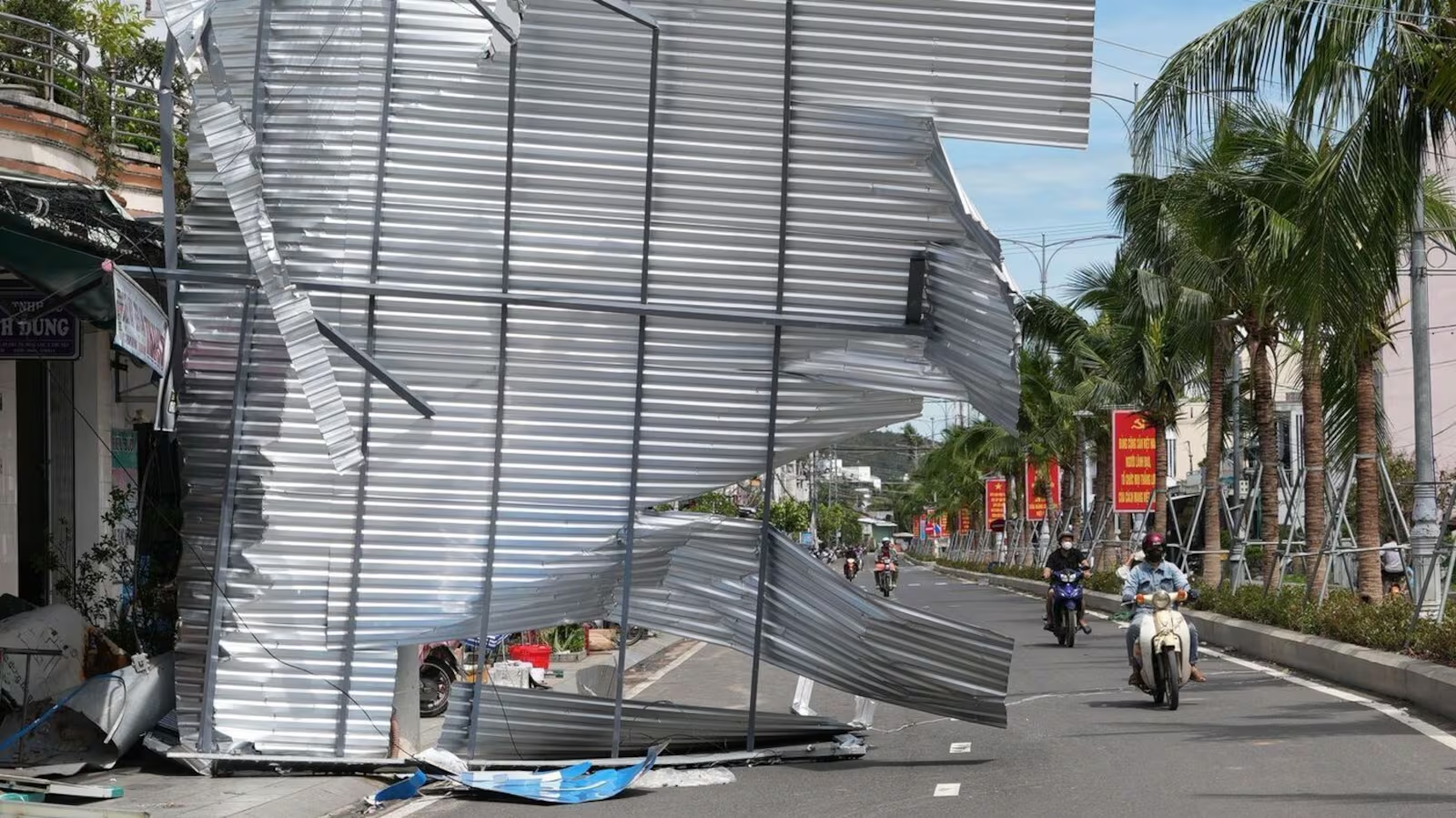
A collapsed building blocked a road in Dak Lak, Vietnam, on Friday, November 7, 2025, after Typhoon Kalmaegi battered the region with powerful winds and heavy rain. AP Photo
Typhoon Kalmaegi tore through Vietnam on Friday, killing at least five people and destroying thousands of homes. Fierce winds and heavy rain flattened houses, tore off roofs, and uprooted trees across several provinces.
The storm hit Dak Lak, Gia Lai, and Quang Ngai, leaving streets flooded and power lines down. More than 1.6 million households lost electricity, while nearly 2,600 homes were damaged or destroyed.
Factories in Binh Dinh province also suffered major damage, losing equipment and roofs to floodwaters. In Quy Nhon, residents woke to find debris and metal sheets scattered across the roads.
By Friday afternoon, locals began clearing the wreckage. Families patched roofs, swept out mud, and dried belongings in the sun as the skies finally cleared.
Vietnam Struggles to Recover
Authorities said the storm struck just as central Vietnam was recovering from weeks of flooding caused by earlier storms. Before Kalmaegi made landfall, officials evacuated over half a million residents, many by boat.
Three fishermen went missing when their boat capsized near Ly Son Island, but rescue efforts were suspended as weather conditions worsened.
Kalmaegi weakened into a tropical storm by evening and moved toward Cambodia, leaving behind destruction across the region. Officials warned that some areas received up to 600 millimetres of rain, causing record river levels and landslides.
Grief in the Philippines
Earlier in the week, Kalmaegi had already brought tragedy to the Philippines, where at least 204 people were killed and 109 remain missing. Torrential rains triggered flash floods and landslides across the central province of Cebu, where entire communities were swept away.
In Cebu City, families gathered Friday to mourn their dead. Rows of white coffins filled a local gymnasium turned temporary funeral hall.
Among the mourners was Jimmy Abatayo, who lost his wife and nine relatives in the floods. “I told them to swim,” he said tearfully. “But I never saw them again.”
President Ferdinand Marcos Jr. has declared a state of national emergency as the country braces for another storm — Typhoon Fung-wong, known locally as Uwan. Meteorologists expect it to hit northern Aurora province early next week, with potential impacts on Manila.
The Philippine weather bureau warned the new storm could span over 1,400 kilometres, bringing more heavy rainfall and strong winds.
A Region Under Strain
Vietnam and the Philippines are no strangers to typhoons, but experts say climate change is making them stronger and more frequent. Kristen Corbosiero, an atmospheric scientist at the University at Albany, said the Pacific has already produced 27 named storms this year — more than usual.
Kalmaegi ranks as the fourth strongest typhoon this season. Scientists warn that rising sea temperatures are fuelling such extreme weather, putting millions in danger every year.