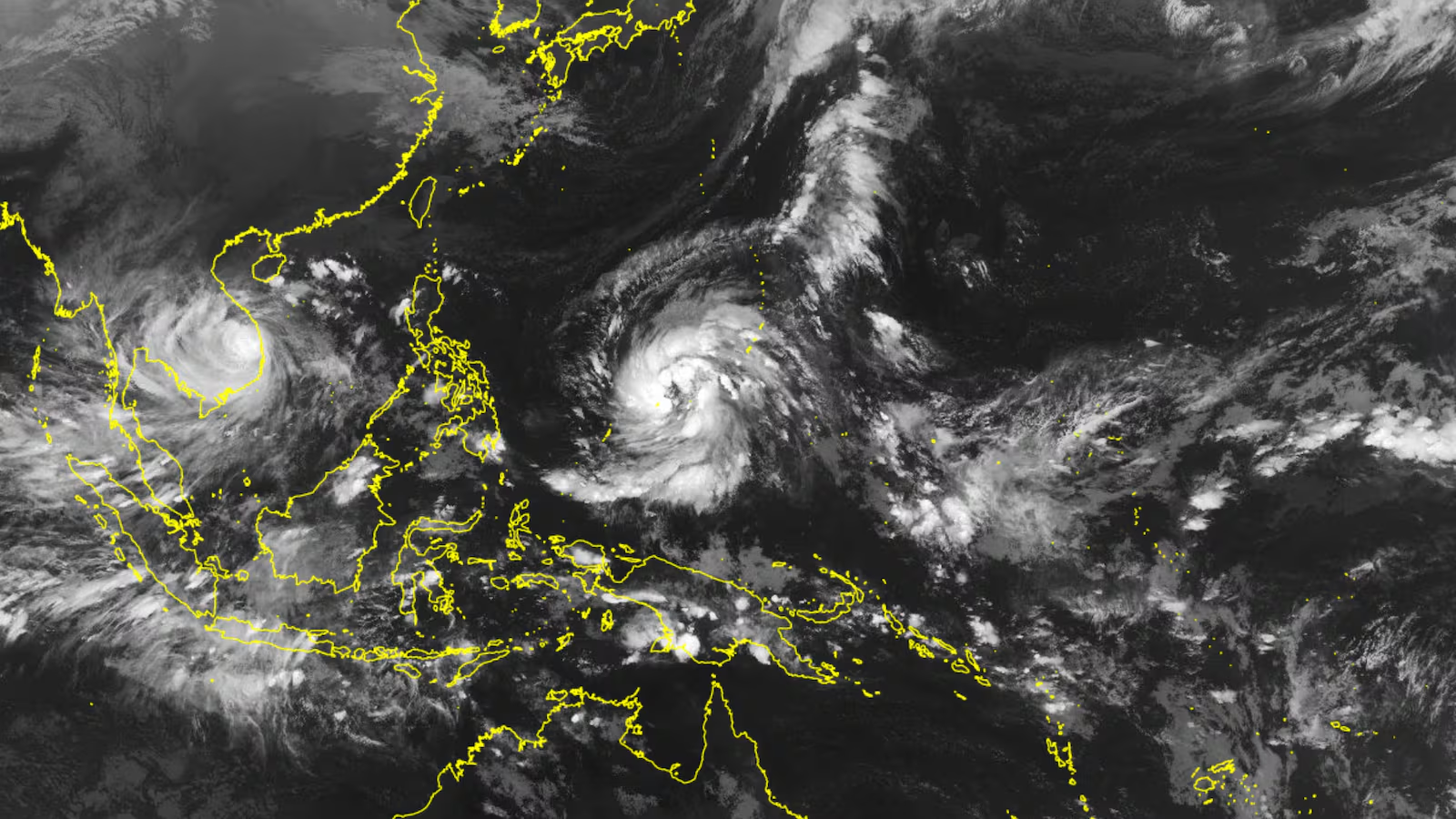
A satellite image captured by the Japanese Meteorological Agency is seen on Thursday, November 6, 2025. Japanese Meteorological Agency
Typhoon Kalmaegi tore through central Vietnam on Friday, bringing powerful winds, heavy rain, and widespread destruction just days after it devastated the Philippines, where hundreds of people were killed or remain missing.
The storm, which weakened to a tropical system as it moved inland, caused major damage to buildings, power lines, and trees across Gia Lai and Dak Lak provinces. State media confirmed two deaths in the region as floodwaters rose and strong winds battered communities.
Vietnamese authorities said over 537,000 residents were evacuated from low-lying and coastal areas. Many were taken to temporary shelters by boat as landslides and flash floods threatened their homes.
Record heat, fierce winds, and rising waters
Before reaching Vietnam, Typhoon Kalmaegi packed winds up to 183 km/h, with gusts reaching 220 km/h over the South China Sea. As it made landfall, the storm generated three-metre waves, flooding coastal cities like Danang and Quy Nhon.
In Dak Lak province, trees were torn from the ground, and entire neighbourhoods lost power for hours. In Ho Chi Minh City, authorities warned of severe flooding as high tides combined with heavy rain expected to reach 100 millimetres.
Meteorologists said Kalmaegi would continue to move through Laos and into northeast Thailand, where officials warned of “very heavy rainfall” and possible flash floods.
Fishermen missing as search halted
In Quang Ngai province, three fishermen were reported missing after their boat was swept away by massive waves near Ly Son island. Rescue crews launched a search but suspended operations later in the day as weather conditions worsened.
The storm added to Vietnam’s already heavy toll from recent floods and storms. Officials said some areas could see more than 60 centimetres of rainfall, raising fears of further landslides and crop destruction.
Philippines declares national emergency
In the Philippines, Kalmaegi was far deadlier. The Office of Civil Defense reported at least 188 deaths and 135 people missing, making it the most destructive natural disaster to strike the country this year. More than 560,000 residents were forced from their homes, with 450,000 sheltering in evacuation centres.
President Ferdinand Marcos Jr. declared a state of national emergency on Thursday as the country braced for another incoming storm — Typhoon Fung-wong (Uwan) — expected to hit the western coast within days.
Marcos travelled to Cebu, the hardest-hit province, where floods destroyed hundreds of homes and swept away vehicles. “We suffered many deaths,” he said, calling the aftermath “very grave.”
The president said the government’s biggest challenge now is ensuring relief workers can continue operations while preparing for the next typhoon.
A relentless storm season
Vietnam and the Philippines are among the most disaster-prone nations in the world. Vietnam has already endured several major storms this year, including Ragasa, Bualoi, and Matmo, which together killed more than 85 people and caused over $1.3 billion in damage.
Experts warn that rising global temperatures are intensifying tropical storms, leading to heavier rainfall and greater destruction across Southeast Asia.
For now, both countries face the difficult task of recovery as Kalmaegi continues its deadly path toward Thailand, leaving behind wrecked homes, flooded cities, and grieving families.