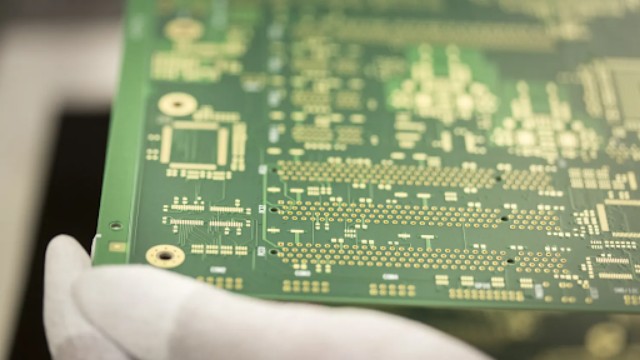
A close-up view of an unused circuit board captured in Verl, Germany. Photo credit: Ute Grabowsky / Photothek / Getty Images.
In a move that signals a softening in trade tensions, the United States has lifted export restrictions on chip design software to China. Two major American semiconductor software giants, Synopsys and Cadence, confirmed the decision on Thursday.
Synopsys, headquartered in California, stated it is actively restoring access to its previously restricted software in China. Cadence, its main competitor, also confirmed that the U.S. Bureau of Industry and Security — part of the Commerce Department — has reversed the earlier export curbs. “We are in the process of restoring access to our software and technology for affected customers while fully complying with U.S. export laws,” a Cadence spokesperson told CNBC.
The Department of Commerce did not immediately issue any public response regarding the update.
Earlier Export Ban Caught Industry Off Guard
Just last week, the U.S. reportedly instructed chip design software companies to seek special licenses before exporting to China. The restricted goods included not only software but also critical chemicals used in semiconductor development.
Siemens EDA — a U.S. subsidiary of Germany’s Siemens — was also impacted by the ban. However, the company has reportedly been cleared to resume operations with China as well.
Market Reacts Quickly
Investors welcomed the news. Shares of Synopsys jumped more than 6%, while Cadence rose over 7% in overnight trading on Robinhood. The positive reaction underlines how closely the market watches U.S.-China tech relations.
These firms are key players in the electronic design automation (EDA) sector — a niche dominated by American technology. EDA includes both software and hardware used in chip development, which is the backbone of modern electronics.
In 2024, Synopsys led the global EDA market with a 31% share. Cadence followed closely with 30%, while Siemens EDA held 13%, according to research group TrendForce.
Trade Truce in the Air
The rollback comes on the heels of fresh dialogue between the U.S. and China. Last week, China signalled its intention to cool tensions, hinting at a potential trade truce. It also agreed to conditionally restart the exchange of rare earth materials and high-end technology — two areas previously under strict control.
This renewed openness appears to be paving the way for a more cooperative approach between the two global economic powers, especially in the sensitive tech sector.