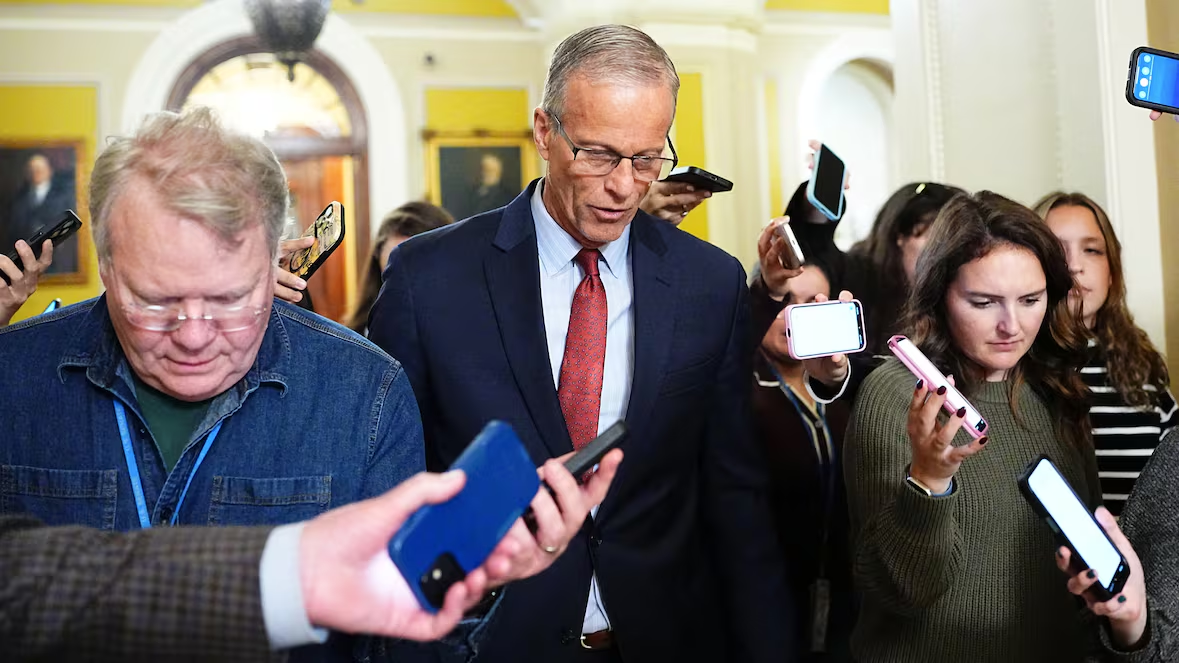
U.S. Senate Majority Leader John Thune spoke outside the Senate Chamber in Washington, D.C., on Sunday. He said the deal would guarantee that federal employees get their back pay. Reuters
The U.S. Senate took an important first step Sunday toward ending the longest government shutdown in American history. Lawmakers voted 60–40 to move forward on a compromise funding bill after weeks of gridlock.
The breakthrough came when a group of moderate Democrats agreed to proceed without securing an immediate extension of Affordable Care Act (ACA) subsidies. The decision angered many Democrats, who argue that health care support should remain a top priority.
Divided Democrats
While some Democrats saw the move as progress, others viewed it as a setback. Senate Minority Leader Chuck Schumer of New York voted against the plan, joined by most members of his caucus.
“We will not give up the fight,” Schumer said, insisting the party must keep pushing to protect affordable health coverage.
Supporters of the deal included Senators Jeanne Shaheen and Maggie Hassan of New Hampshire, Angus King of Maine, and several others who said reopening the government must come first. Their proposal funds parts of the government until late January and promises a December vote on extending the ACA tax credits that are set to expire January 1.
What the Deal Includes
The agreement would reinstate thousands of federal employees who lost their jobs during the shutdown and ensure all workers receive back pay. It also funds key areas like food aid, veterans’ services, and the legislative branch.
Republicans released text for three spending bills covering a full year. These bills include increased security for lawmakers and a measure to block the sale of certain hemp products.
Senator John Thune, the Republican majority leader, praised the progress. “The time to act is now,” he said.
President Donald Trump, speaking later that evening, hinted that the end might be near. “It looks like we’re getting close to the shutdown ending,” he said after returning from a football game.
Pressure Mounts as Shutdown Impacts Grow
The shutdown, which began October 1, had caused widespread disruption across the country. Flights were cancelled or delayed, federal workers went unpaid, and food assistance programs were at risk.
As talks dragged on, frustration grew in both parties. Even some Republican senators pushed for quick action, saying Americans were losing patience.
In the end, three conservative Republicans—Mike Lee of Utah, Rick Scott of Florida, and Ron Johnson of Wisconsin—held back their votes until speaking with Trump. Once reassured, they joined to pass the 60-vote threshold.
Divisions Remain
Despite progress, many Democrats said the compromise didn’t go far enough. Senator Bernie Sanders called it a “horrific mistake,” and Senator Chris Murphy said voters had supported Democrats to stand firm on health care.
Others, like Senator Tim Kaine of Virginia, backed the plan but stressed it must lead to real solutions. “We need to fix the Republicans’ health care mess and protect workers,” he said.
Meanwhile, some progressive Democrats in the House of Representatives strongly opposed the deal. Representative Greg Casar of Texas said, “Accepting nothing but a pinky promise from Republicans isn’t a compromise — it’s surrender.”
Looking Ahead
If the Senate and House approve the plan, parts of the government could reopen by midweek. A separate vote in December will determine the fate of the ACA subsidies.
For now, both parties face pressure to end the shutdown that has lasted more than a month, leaving millions of Americans caught in the middle.