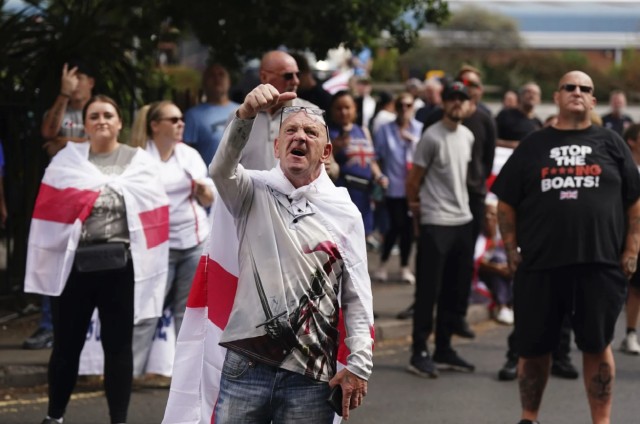
People demonstrating under the Abolish Asylum System slogan outside the Castle Bromwich Holiday Inn in Birmingham, England, Sunday, Aug. 24, 2025.
Opponents and supporters of migrants clashed across Britain during the holiday weekend. The protests erupted after a court ruling ordered the eviction of asylum-seekers from a hotel in a London suburb.
The decision has complicated the government’s efforts to manage migration and meet its duty to accommodate asylum-seekers. Immigration has become one of the most divisive issues in UK politics, reflecting broader challenges faced by Western nations grappling with rising arrivals.
Protests Trigger Heated Confrontations
Tensions spiked after weeks of demonstrations outside the Bell Hotel in Epping. The protests followed allegations that a migrant resident attempted to kiss a 14-year-old girl. He faces trial later this month and denies the charges.
Epping Forest District Council sought a temporary injunction to close the hotel, citing “unprecedented disruption” and multiple arrests. The High Court backed the council’s request, but the government intends to appeal.
The ruling encouraged anti-migrant activists under the banner Abolish Asylum System to rally over the weekend. In response, Stand Up to Racism mobilized counterprotesters.
Both sides clashed in towns like Bristol, exchanging insults as police struggled to maintain order. Over a dozen arrests were made, though no serious violence occurred. Smaller gatherings also took place outside hotels in Birmingham and London’s Canary Wharf.
Hotels at the Center of Migrant Debate
The UK government has a legal obligation to provide shelter for asylum-seekers. Hotels became a key part of that system in 2020 after applications rose sharply.
According to the Home Office, asylum claims reached a record 111,084 in the year to June 2025. Only a fraction of applicants, however, are housed in hotels.
By the end of June, about 32,000 asylum-seekers were living in hotels—an 8% rise from last year but significantly below the 2023 peak of 56,000.
Politics Driving Migrant Protests
Immigration has become a powerful political weapon. Reform UK leader Nigel Farage has linked migration to crises in housing and health care. Critics accuse him of inflaming tensions for political gain.
Opposition leader Kemi Badenoch urged Conservative councils to pursue legal action similar to Epping. Labour dismissed her comments as “desperate nonsense,” but some Labour councils also signaled willingness to challenge asylum housing.
The government fears that growing unrest could fuel violence similar to last summer’s riots. Those clashes followed a tragic stabbing in a dance class that left three girls dead.
Government Scrambles for Solutions
The government’s immediate priority is reducing English Channel crossings. So far this year, more than 27,000 people have arrived—nearly 50% higher than last year.
Prime Minister Keir Starmer scrapped the Rwanda deportation plan introduced by the previous government. Instead, he pledged to dismantle smuggling networks and expand cooperation with France. The UK hopes faster asylum claim processing will also ease pressure.
Housing asylum-seekers remains a central challenge. The government has already ended the use of a migrant barge and plans to close military barracks in Kent. A former air base in Essex is now being prepared to accommodate more arrivals.
Using private rental housing remains an option, but it could worsen an already strained property market in a country struggling with low homebuilding rates.
A Divisive Debate With No Easy Answers
The UK migrant protests highlight the political and social fractures surrounding immigration. While some see asylum as a humanitarian duty, others view it as an economic and security burden.
As channel crossings rise and legal battles over asylum housing continue, the government faces tough choices. For now, the protests show no sign of ending, and the debate over migrants in Britain is set to intensify further.