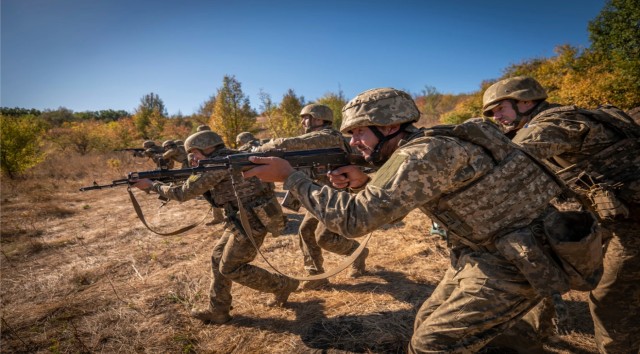
Ukraine's Soldiers of 66th Brigade attend a training combat exercise in Dentsk region, Ukraine, Sept 25, 2025.
The war in Ukraine has entered another complex phase. Ukraine’s front line has now extended to nearly 1,250 kilometers, placing additional strain on Kyiv’s forces. Russia, meanwhile, has shifted its approach on the battlefield, relying less on large-scale offensives and more on smaller, scattered assault groups.
Ukraine Front Line Under Pressure
According to Ukraine’s top military commander, Gen. Oleksandr Syrskyi, the line of contact has grown by 200 kilometers over the past year. Ukrainian forces now face an average of 160 to 190 combat engagements daily. This growing front line has forced Ukraine to stretch its defenses against a larger Russian army.
Russia’s “Thousand Cuts” Tactic
Instead of relying on costly mass assaults, Russia has turned to what Syrskyi calls the “thousand cuts” tactic. Small assault units, often made up of four to six soldiers, move under the cover of terrain. They attempt to infiltrate Ukrainian defenses and strike supply lines or disrupt troop rotations.
Syrskyi explained that while these groups create disruption, they are often cut off and surrounded by Ukrainian counterattacks. Still, the constant pressure has made the Ukraine front line more volatile.
Russia’s Firepower Advantage
Russian forces continue to fire nearly twice as many artillery shells as Ukraine. Alongside drones, missiles, and glide bombs, Moscow has been relentless in trying to push Ukrainian defenders back, particularly in rural areas. However, despite these efforts, Russia has not been able to secure key urban centers, which remain strongholds for Ukraine.
Ukrainian Counteroffensive Gains
Despite the challenges, Syrskyi reported that Ukraine recently regained control of 168 square kilometers of territory. These counteroffensive actions highlight Ukraine’s ability to strike back and reclaim ground even as the front line grows.
Ukraine’s long-range strike program has also delivered significant blows to Russian military and industrial facilities. In recent weeks, Ukrainian forces have intensified attacks deep inside Russian territory.
Drones Reshape the Battlefield
Ukraine’s newly established Unmanned Systems Forces are playing a decisive role. In less than two months, they launched 85 successful strikes inside Russia. Targets included 33 military facilities and 52 plants producing weapons, ammunition, engines, rocket fuel, and drones.
Syrskyi credited these drone attacks with creating a fuel shortage in Russia. This shortage, he said, is now disrupting Moscow’s logistics and weakening its ability to supply frontline troops.
Preparing for Winter Battles
As winter approaches, Ukraine expects Russia to escalate attacks on its power grid. To prepare, Kyiv is reinforcing its air-defense system. This includes interceptor drones, helicopters, light aircraft, and advanced electronic warfare tools.
According to Syrskyi, Ukraine’s new interceptors are already successful 70% of the time against Russian drones. The military is also testing light fixed-wing aircraft equipped with machine guns as a countermeasure.
International Outlook
While Ukraine fights to hold the front line, international political efforts remain uncertain. U.S. President Donald Trump recently suggested Ukraine could still reclaim lost territory, which accounts for about 20% of the country. However, diplomatic initiatives to end the war have made little progress.
A Battle of Endurance
The Ukraine front line continues to evolve as both sides adapt strategies. Russia’s reliance on smaller assault groups poses new challenges, while Ukraine leverages technology and precision strikes to hold its ground. As winter nears, the conflict shows no sign of slowing, and both armies are preparing for an even harsher phase of the war.