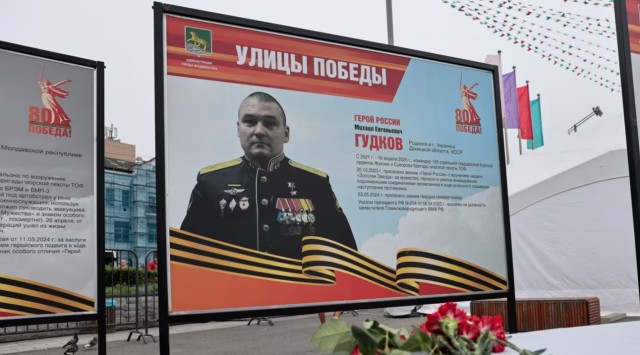
Flowers placed in front of a photograph of Maj. Gen. Mikhail Gudkov, the deputy head of the Russian Navy who was recently killed in the Kursk region, at an exhibition of distinguished Russian soldiers' portraits in the far eastern city of Vladivostok, Russia, on Thursday.
Ukraine has dealt a major blow to Russia’s military command, killing Guards Maj. Gen. Mikhail Gudkov, one of the highest-ranking Russian officers to die since the full-scale invasion began in 2022.
The strike took place in Russia’s Kursk region, near the border with Ukraine, an area that has witnessed repeated clashes and incursions over the past year. Gudkov served as Deputy Commander-in-Chief of the Russian Navy, responsible for coastal and ground forces. His death marks a significant loss for Russia’s naval leadership.
Gudkov’s Death Confirmed by Russian Officials
On Thursday, Oleg Kozhemyako, governor of the Primorsky region in Russia’s far east, confirmed Gudkov's death. The two were reportedly close, and Kozhemyako had personally awarded Gudkov for his service in the past.
He described Gudkov as a “strong-willed warrior” who died while “performing his duty alongside fellow soldiers.” However, no further information was provided about the specific circumstances of his death.
Shortly after Kozhemyako’s statement, Russia’s Ministry of Defense confirmed Gudkov had died in combat in the Kursk region. Ukraine has yet to issue a public statement on the incident.
A High-Ranking Loss for Russia
Gudkov was a key figure in the Russian military hierarchy. In March, President Vladimir Putin appointed him as Deputy Chief of the Russian Navy, overseeing ground and coastal forces.
Putin praised Gudkov's combat experience, stating that it should be “replicated in other units.” His promotion was seen as part of a broader effort to integrate experienced battlefield commanders into higher-level strategic roles.
Gudkov had also commanded the 155th Marine Brigade, a unit that had seen intense combat in Ukraine and had been accused of serious human rights violations.
Controversial Legacy in Ukraine
Gudkov’s battlefield history is shadowed by allegations of war crimes in Ukraine. The Ukrainian military had previously accused him and his former brigade of committing atrocities against civilians in towns like Bucha, Irpin, and Gostomel during the early stages of the war.
These towns became international symbols of Russian brutality after investigators discovered mass graves and widespread civilian killings.
Additionally, Ukraine’s State Border Guard Service has accused the 155th brigade of executing Ukrainian prisoners of war — another serious charge that adds to the long list of human rights violations Russia is accused of.
Despite mounting evidence and international scrutiny, Russia continues to deny all allegations of war crimes, calling them fabrications by Ukraine and its allies.
Strategic Impact of Gudkov’s Death
The loss of such a senior officer comes at a time when the Kursk region remains highly volatile. Ukraine has carried out several cross-border raids and drone attacks in the area over the past year, successfully targeting fuel depots, radar systems, and now, high-ranking commanders.
This incident underscores Ukraine’s continued ability to strike deep into Russian territory and disrupt its military command structure.
Gudkov’s death also raises questions about the security of Russian leadership near conflict zones and whether Moscow underestimated Ukraine’s reach and intelligence capabilities.
Conclusion: A Blow with Symbolic and Tactical Weight
As the war stretches into its third year, Ukraine’s ability to eliminate top Russian commanders like Gudkov signals a tactical evolution. Beyond the battlefield, such strikes deal psychological blows to Russian forces and may further erode confidence in the leadership’s ability to protect its own.
While Russia honours Gudkov as a hero, Ukraine and its allies may view his death as a step toward justice for those who suffered under his command.