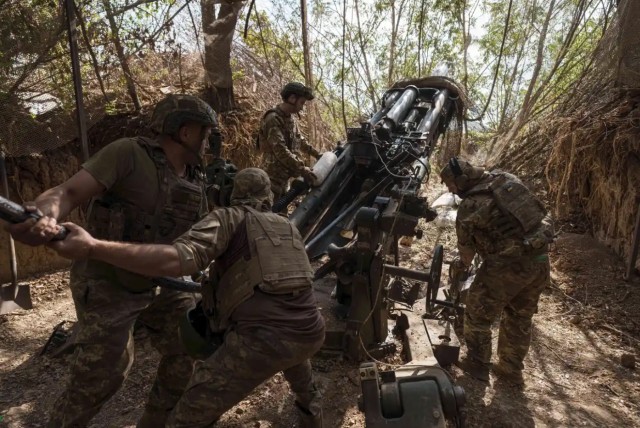
Ukrainian servicemen of the 148th artillery brigade load ammunition into a M777 howitzer before firing towards Russian positions at the frontline in Zaporizhzhia region, Ukraine, on Thursday, Aug. 7, 2025.
Russian forces have advanced in eastern Ukraine just days before the highly anticipated Putin-Trump summit in Alaska. The timing raises fears that Moscow will use battlefield gains to strengthen its bargaining power at the negotiating table.
Analysts warn the latest Russian moves could reshape discussions between Washington and Moscow, leaving Kyiv under new pressure.
Russian Advances in Donetsk Raise Alarm
This week, Russian troops breached Ukrainian defenses in the Donetsk region. Small infiltrations turned into deeper pushes, forcing Ukraine to reinforce its lines.
The industrial hub of Pokrovsk is now partly encircled. Once home to 60,000 residents, the city has become a focal point of Russia’s campaign.
Forces also found a weak spot east of Dobropillia and advanced about 10 kilometers. Analysts say this breach, if not contained, could become a bigger crisis.
A Risky Moment Before the Summit
Ukrainian President Volodymyr Zelenskyy believes Russia’s actions are designed to influence the upcoming summit. He said Moscow wants to present Ukraine as weak to pressure the U.S. into concessions.
Zelenskyy rejected any deal that would force Ukraine to give up the 30% of Donetsk still under its control. Russia illegally annexed Donetsk in 2022, but has failed to take full control.
Mykola Bieleskov, a Kyiv-based analyst, warned that local gains could be turned into “strategic victories” at the negotiation table.
Infiltration Tactics and Gaps in Ukraine’s Defenses
Russian troops are advancing in small groups, slipping past first defense lines and regrouping in hidden positions. This tactic creates constant pressure on Ukraine’s overstretched infantry.
Ukraine’s military admits the situation near Dobropillia has not fully stabilized. Troops are repelling assaults but facing manpower shortages.
A Ukrainian drone pilot described how Russia exploits weak spots. “We pay with territory and lives to fix mistakes,” he said.
The Role of Drones in the Battlefield
To counter infiltration, Ukrainian forces have relied heavily on first-person-view drones. These explosive drones turn wide areas into deadly zones for Russian soldiers.
Yet, the tactic has limits. Drone operators cannot launch massive swarms at once without interfering with each other. Small Russian groups often slip through despite the drone strikes.
Analyst Bieleskov explained the challenge: both sides use similar tactics and technology. However, Russia’s larger manpower gives it a brutal advantage. “They have no regard for human life,” he said.
Reinforcements and the Azov Brigade
Ukraine has moved additional forces to plug gaps, including the battle-hardened Azov brigade. However, independent battlefield maps show no clear shift in Ukraine’s favor.
Stopping Russian infiltration requires new defensive structures and leadership changes, experts argue. Without them, Russia’s pressure could widen into a larger breakthrough.
Russia Targets Supply Routes
Military analysts say Russia’s real goal is to expand breaches into corridors that cut Ukrainian supply lines. Instead of storming fortified cities, Moscow is pushing across open ground where Ukraine struggles to defend.
If supply routes collapse, key strongholds like Kostiantynivka could fall without heavy fighting. Losing this hub would leave Sloviansk, Kramatorsk, and Druzhkivka vulnerable.
Commander Serhii Filimonov of the “Da Vinci Wolves” battalion warned that logistics are already strained. With few major roads, holding the region could become “extremely difficult.”
Summit Overshadowed by Battlefield Losses
As the Putin-Trump summit approaches, Ukraine fears Moscow will use the fighting as leverage. Russian President Vladimir Putin is expected to argue that Kyiv’s position is collapsing.
Ukrainian commanders, however, stress that the fight is far from over. They accuse Moscow of committing atrocities while seeking recognition from the world.
Filimonov voiced frustration with Western diplomacy. “They kill, and then the world says, ‘Fine, let’s make a deal.’ That’s not right.”
What Lies Ahead
The coming weeks will test Ukraine’s ability to hold defensive lines under pressure. With Russia intensifying attacks and the summit looming, the battlefield has become a political tool.
Whether Moscow achieves a breakthrough or Ukraine stabilizes the front may influence negotiations in Alaska. For Kyiv, every kilometer now carries both military and diplomatic weight.