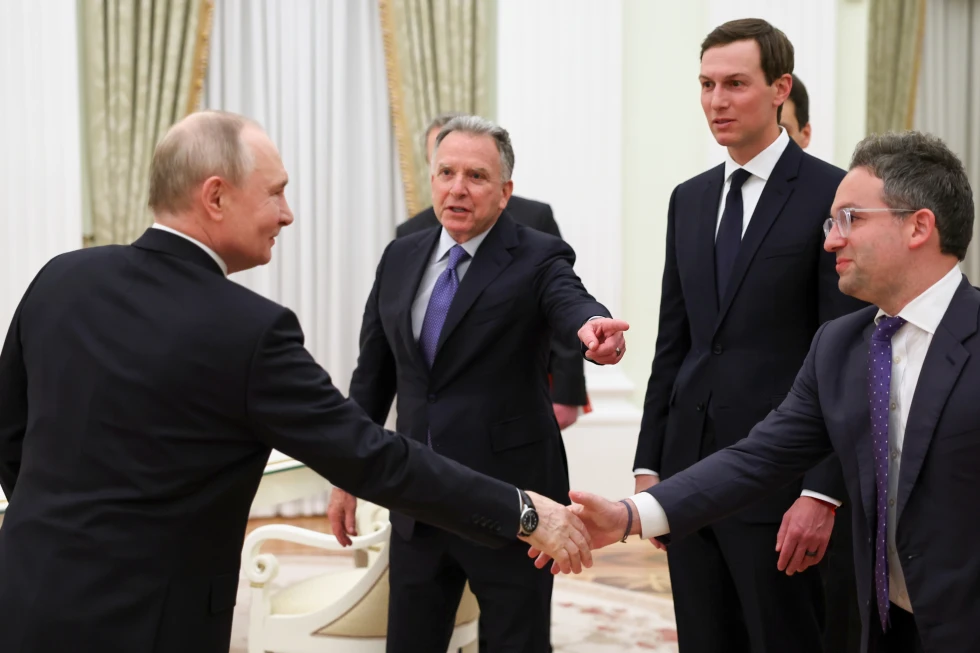
Russian President Vladimir Putin, left, greets U.S. President Donald Trump’s envoys Steve Witkoff, center left, Jared Kushner, second right, and Josh Gruenbaum, the head of the Federal Acquisition Service at the General Services Administration, at the Senate Palace of the Kremlin, in Moscow, Thursday, Jan. 22, 2026.
Negotiators from Ukraine, Russia, and the United States met in Abu Dhabi to discuss ending the war.
The nearly four-year conflict has devastated Ukraine and reshaped global geopolitics.
At the center of the talks lies a sensitive issue: territorial concessions in eastern Ukraine.
Ukrainian President Volodymyr Zelenskyy said the future of the Donbas region dominates discussions.
The area remains partially occupied by Russian forces after years of fighting.
Zelenskyy called the issue difficult but unavoidable in any peace settlement.
Abu Dhabi Becomes Key Diplomatic Stage
The UAE’s foreign ministry confirmed the Ukraine-Russia talks began Friday and continued Saturday.
Officials said the meetings aim to promote dialogue and political solutions.
The White House described the early discussions as productive and constructive.
This marks a rare moment of direct engagement involving all three sides.
Observers say it signals cautious movement toward a negotiated outcome.
Still, major disagreements remain unresolved.
Putin’s Preconditions Shape the Talks
Hours before the Abu Dhabi meetings, Russian President Vladimir Putin met U.S. envoys.
The overnight talks included Steve Witkoff and Jared Kushner.
The Kremlin stressed its firm stance on territorial control.
Russia insists Ukraine must withdraw troops from eastern regions Moscow claims to have annexed.
These territories are not fully under Russian control.
The Kremlin says resolving territorial issues is essential for lasting peace.
Zelenskyy Signals Conditional Openness
Zelenskyy said peace proposals are “nearly ready” but unresolved.
He spoke after meeting U.S. President Donald Trump in Davos.
The status of occupied land remains the greatest obstacle.
The Ukrainian leader reiterated interest in a Ukraine-controlled free trade zone in the east.
He said the proposal could boost regional business and recovery.
Zelenskyy described his discussion with Trump as positive.
Inside the Ukraine, Russia Talks
In a late-night address, Zelenskyy said his delegation reported hourly updates.
“They are discussing parameters for ending the war,” he said.
He urged Russia to show genuine readiness to stop the conflict.
Zelenskyy cautioned against early conclusions.
He said progress depends on Russia’s willingness to compromise.
Saturday’s talks were expected to test that resolve.
Moscow Reaffirms Its Red Lines
The Kremlin labeled the meeting a security working group.
Spokesman Dmitry Peskov emphasized troop withdrawal as a core demand.
He also hinted at additional undisclosed conditions.
Russian adviser Yuri Ushakov said territorial questions must be settled first.
He called talks with U.S. officials frank and fruitful.
State media reported discussions on buffer zones and control mechanisms.
Who Is at the Table
Russia’s delegation is led by Admiral Igor Kostyukov and military officials.
Economic talks involve Putin’s envoy Kirill Dmitriev.
The U.S. team includes Witkoff, Kushner, and senior defense leaders.
Ukraine’s delegation features top security and military officials.
They include Rustem Umerov, Andrii Hnatov, and Kyrylo Budanov.
All sides describe the talks as complex but necessary.
Trump-Zelenskyy Meeting Adds Momentum
Trump met Zelenskyy privately at the World Economic Forum.
The meeting lasted about an hour behind closed doors.
Both leaders later called it meaningful.
Trump said both Putin and Zelenskyy want a deal.
He acknowledged boundaries remain the key sticking point.
He noted similar obstacles have stalled talks for months.
War Pressures Mount on Both Sides
Russia controls about 20 percent of Ukraine’s territory.
Its gains came at heavy military and economic costs.
Sanctions continue to strain Moscow’s economy.
Ukraine faces funding shortages and manpower challenges.
Despite boosting domestic arms production, it needs Western support.
Officials report widespread desertions and draft evasion.
Zelenskyy Criticizes Europe’s Role
At Davos, Zelenskyy sharply criticized European allies.
He accused Europe of slow decisions and weak defense spending.
He also cited inaction on Russia’s shadow oil fleet.
Zelenskyy urged Europe to become a stronger global force.
He compared repeated warnings to the movie “Groundhog Day.”
“A year has passed, and nothing has changed,” he said.
The Ukraine-Russia talks now continue under intense global scrutiny.
Their outcome could redefine the future of the region.