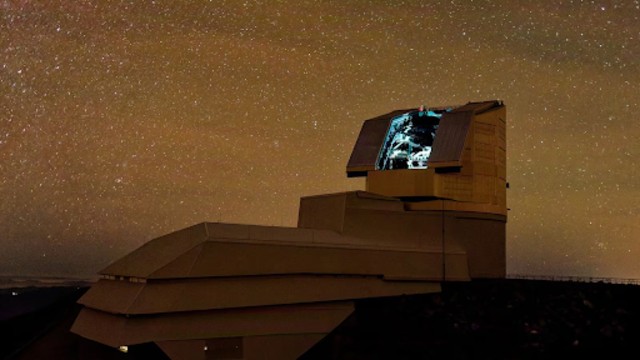
The night sky dazzles above the Vera C. Rubin Observatory in Cerro Pachon, Chile on June 8. Beginning in early 2026, the observatory's decade-long Legacy Survey of Space and Time will generate an ultra-wide, ultra-high-definition time-lapse record of the universe. (Getty Images)
A long-standing belief in modern cosmology is back under scrutiny. A new study claims that the universe may no longer be accelerating. Instead, it could be slowing down — a possibility that challenges a major scientific pillar built over the last 25 years.
A Challenge to a Nobel-Winning Idea
In 1998, two independent teams studying Type Ia supernovas found these distant stellar explosions dimmer than expected. They concluded that the universe was expanding faster than models predicted. This discovery reshaped cosmology and earned a Nobel Prize in 2011.
But dark energy, the mysterious force blamed for this acceleration, has always been difficult to explain. And recent findings suggest its strength may not be constant after all.
New Clues From DESI
Last year, researchers from the DESI project created the largest 3D map of the cosmos. Their observations hinted that dark energy might be weakening. If true, the universe’s expansion could slow down in the future.
The new study, published November 6 in the Monthly Notices of the Royal Astronomical Society, takes this idea further. It proposes that the slowdown has already begun.
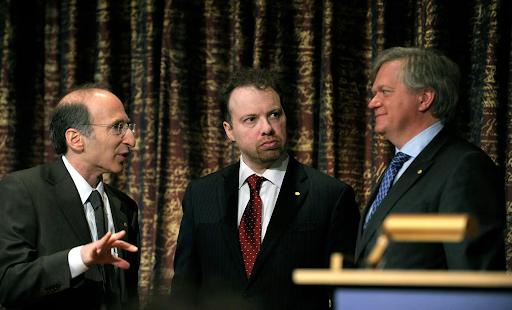
The 2011 Nobel Prize laureates in physics (from left) Saul Perlmutter, Adam Riess and Brian P. Schmidt chat during a news conference at The Royal Swedish Academy of Sciences in Stockholm in December 2011. (Reuters via CNN Newsource)
A Shift in Cosmic Destiny
Lead researcher Young-Wook Lee from Yonsei University believes this signals a major shift. According to Lee, dark energy still exists, but its influence has changed. The universe, he says, may have already transitioned into a decelerating phase.
Such a shift could alter what scientists predict about the universe’s final fate. For decades, the idea of a “Big Crunch” seemed improbable. Now, Lee says, it can no longer be dismissed.
Rethinking Supernova “Standard Candles”
The study’s conclusions come from a detailed look at 300 galaxies hosting Type Ia supernovas. These explosions were long treated as “standard candles” because of their reliable intrinsic brightness.
But coauthor Junhyuk Son says that assumption was flawed. Their analysis shows that a supernova’s brightness depends on the age of the progenitor star. Younger stars produce slightly dimmer explosions. Older stars create brighter ones.
This age-brightness link, supported at 99.99 percent confidence, changes how these supernovas should be used to measure cosmic expansion. And it suggests that earlier readings may have overstated acceleration.
A Potential Breakthrough — If It Holds
If verified, Son says this could be the biggest shift in cosmology since 1998. It would imply that dark energy evolves, not acts as a constant force. That change could rewrite our understanding of cosmic history and the universe’s long-term future.
Deep Skepticism From Leading Experts
However, not everyone is convinced.
Adam Riess, a Nobel laureate and one of the scientists behind the original acceleration discovery, dismisses the study’s premise. He argues that today’s supernovas occur in younger star-forming regions, not older ones.
Other astronomers also challenge the assumptions behind the new model. Duke University’s Dan Scolnic says earlier studies have already accounted for the effects the team describes. He insists the universe is “still accelerating just fine.”
Dillon Brout of Boston University agrees that questioning assumptions is healthy. But he argues that the new model contradicts observations and modern understanding of stellar systems.
Physicist Dragan Huterer from the University of Michigan says the evidence is still far from strong enough to overturn accepted theories.
A Debate Just Getting Started
Lee acknowledges the pushback. He says more data is needed to convince the scientific community. Fortunately, that data may arrive soon.
The Vera C. Rubin Observatory will begin the Legacy Survey of Space and Time in 2026. It is expected to identify more than 20,000 new supernova host galaxies with precise age measurements. That could help resolve the debate within a few years.
For now, the mystery deepens. As Lee puts it, dark energy “is getting weirder,” and the universe may be holding surprises that defy current theory.