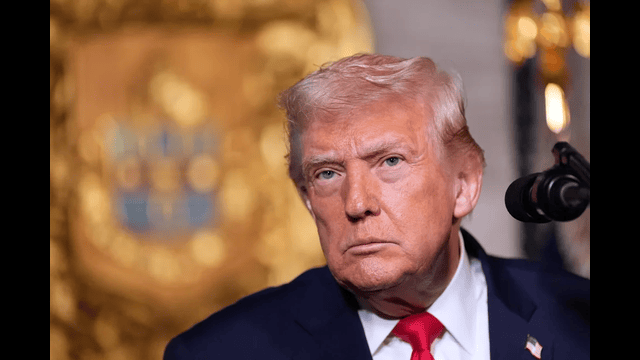
President Donald Trump speaks at his Mar-a-Lago club, Monday, Dec. 22, 2025, in Palm Beach, Fla
President Donald Trump announced US airstrikes in Nigeria targeting Islamic State militants on Christmas evening.
He described the operation as “powerful and deadly.”
The strikes followed weeks of sharp criticism of Nigeria’s handling of religious violence.
Trump shared the announcement on his social media platform.
He offered no operational details or damage assessment.
The statement focused on protecting Christians from extremist attacks.
According to Trump, Islamic State fighters were “viciously killing innocent Christians.”
He said the United States would not tolerate such violence.
The message framed the strikes as a direct response to religious persecution.
Nigeria and the US Confirm Joint Military Action
A senior US Defense Department official confirmed cooperation with Nigeria.
The official spoke anonymously due to the sensitivity of the mission.
He said Nigeria approved and supported the US airstrikes in Nigeria.
Nigeria’s Ministry of Foreign Affairs also acknowledged the operation.
It said cooperation included intelligence sharing and strategic coordination.
The ministry stressed respect for sovereignty and international law.
Officials emphasized that the action aligned with shared security goals.
They said both countries remain committed to regional stability.
The ministry rejected any suggestion of unilateral US action.
Debate Over Who the Violence Targets
Trump’s comments focused heavily on Christian victims.
However, Nigerian officials offered a broader view.
They said extremist violence affects both Christians and Muslims.
Christians are more common in southern Nigeria.
Muslims form the majority in the north.
Both communities have suffered deadly attacks.
“Terrorist violence in any form remains an affront to Nigeria’s values,” the ministry said.
It added that attacks undermine global peace and security.
The statement aimed to balance Trump’s narrative.
Islamic State Groups Operating in Nigeria
Nigeria is battling multiple armed groups across its regions.
Two factions are linked to the Islamic State.
One is Islamic State West Africa Province, a Boko Haram offshoot.
This group operates mainly in northeastern Nigeria.
Another faction, Lakurawa, operates in the northwest.
Lakurawa is less known but increasingly dangerous.
Security analysts believe US airstrikes in Nigeria may have targeted Lakurawa.
The group has expanded rapidly over the past year.
It frequently attacks rural communities and security forces.
Experts Warn of Growing Threat in the Northwest
Malik Samuel of Good Governance Africa highlighted Lakurawa’s influence.
He said the group controls territory in Sokoto and nearby states.
Forested areas provide safe havens for militants.
Samuel blamed weak state presence for the expansion.
Security forces are scarce in many hotspots.
This allows extremist groups to fill the vacuum.
The northwest has seen rising ideological extremism.
Analysts say it mirrors patterns seen in the northeast earlier.
They warn the threat could spread further.
US Pressure Builds on Nigeria
Trump ordered military planning last month.
The goal was to curb what he called Christian persecution.
The Pentagon began preparing possible response options.
The US State Department also took action.
It announced visa restrictions for Nigerians linked to killings.
Family members were included in the sanctions.
Washington recently designated Nigeria a “country of particular concern.”
The label falls under the International Religious Freedom Act.
It increases diplomatic pressure on Abuja.
Complex Causes Behind Nigeria’s Violence
Nigeria has a population of about 220 million.
Christians and Muslims are nearly equal in number.
The country faces multiple overlapping security crises.
Some attacks are religiously motivated.
Others stem from farmer-herder conflicts over resources.
Ethnic tensions and separatist movements also fuel violence.
Boko Haram targets both Christians and Muslims.
It attacks Muslims it considers insufficiently devout.
This complexity challenges simple explanations.
Limited US Military Presence in Africa
The US security footprint in Africa has shrunk.
Several military partnerships have been scaled back.
Others have ended completely.
Any major intervention in Nigeria would be difficult.
Forces might need redeployment from other regions.
Officials have not suggested a long-term deployment.
Still, Trump has maintained strong rhetoric.
He linked recent school and church attacks to extremist failures.
Experts say victims include all faiths.
Strong Messages From US Leadership
Defense Secretary Pete Hegseth reinforced Trump’s stance.
He posted on X late Thursday night.
“The killing of innocent Christians must end,” he wrote.
Hegseth said US forces were ready at all times.
He claimed ISIS “found out on Christmas.”
He thanked Nigeria for its cooperation.
His message ended with “More to come.”
The statement signaled continued US attention.
US airstrikes in Nigeria may not be the last.