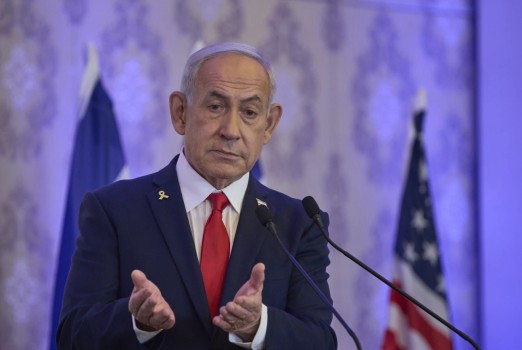
Israeli Prime Minister Benjamin Netanyahu speaks to the audience at a conference in Jerusalem, Sunday, July 27, 2025.
World diplomats are gathering in New York this week to reignite talks on the long-standing Israel-Palestinian conflict. At the heart of the two-day UN meeting is one focus — reviving the two-state solution. The goal is simple in theory but complex in execution: two independent nations, Israel and Palestine, living peacefully side by side. Yet, the road ahead is uncertain, as two key players — Israel and the United States — are not participating.
Israel, US Boycott UN Meet on Two-State Solution
Israel and the United States have decided to sit this one out. Both countries are boycotting the conference, calling it “counterproductive.” Israeli Prime Minister Benjamin Netanyahu strongly opposes the idea of a two-state solution, both on religious and security grounds. Meanwhile, the Biden administration has distanced itself from the talks, focusing instead on ending the war in Gaza.
Despite the absence of these major stakeholders, the conference is moving forward under the leadership of France and Saudi Arabia. They’re co-chairing the meeting, aiming to put a renewed spotlight on the two-state solution — a concept that has shaped decades of peace efforts in the Middle East.
Why the Two-State Solution Still Matters
The idea dates back to 1947, when the UN proposed splitting British-ruled Palestine into separate Jewish and Arab states. Israel accepted, but Arab nations went to war. In 1967, Israel captured the West Bank, East Jerusalem, and Gaza — lands Palestinians now want for their future state.
The two-state solution remains widely supported by the international community. It’s seen as a pathway to preserve Israel’s Jewish identity while granting Palestinians sovereignty and dignity. For many, it’s still the most realistic framework for long-term peace.
A New Push for a Real Peace Road Map
France and Saudi Arabia want this conference to be more than symbolic. They’ve called on all global actors to take concrete steps — including time-bound commitments — to make the two-state solution a reality.
Saudi diplomat Manal Radwan stressed the need for a credible political plan. She said the conference must “chart a course for action,” not just offer reflections.
French President Emmanuel Macron also made headlines ahead of the conference. He announced France will officially recognize the state of Palestine at the UN General Assembly in September. With over 145 countries already doing so, France becomes the most influential Western power to join that list — a move that carries significant weight.
Inside Israel’s Opposition
Netanyahu’s government strongly rejects the two-state framework. Many in his base view the West Bank as sacred Jewish land and believe Palestinians are not serious about peace. They point to the 2000s uprising and Hamas’s control of Gaza since 2007.
Israel also doesn’t support a one-state model, fearing a loss of Jewish majority. Netanyahu appears to prefer the status quo — continued Israeli control, expanding settlements, and limited autonomy for Palestinians in parts of the West Bank.
He also lashed out at France’s recent announcement, warning that recognizing Palestine “rewards terror” and could lead to the creation of another Iranian-backed entity, like Hamas in Gaza.
The Palestinian Perspective
Palestinian officials say the current system amounts to “apartheid.” They accuse Israel of blocking peace through settlement expansion and land annexation plans.
Ahmed Majdalani, a senior PLO official, said the UN meeting is a preparatory step for a possible presidential-level summit in September. He outlined three major goals: restarting peace talks, gaining wider international recognition (particularly from the UK), and securing funds for Gaza’s recovery.
Palestinians are also seeking global backing for the reconstruction of Gaza, devastated by years of war.
What to Expect from the UN Meeting
All 193 UN member states were invited, with around 40 foreign ministers expected to attend. But without the US and Israel, the chances of a major breakthrough are slim.
Still, the meeting could lead to symbolic wins. There may be formal commitments to recognizing Palestine and pushing for peace. A shared outcome document is also in the works.
UN Secretary-General António Guterres has urged nations not to let the two-state solution die. He emphasized the need not just for words, but action — to create real conditions for a peaceful coexistence between Israel and Palestine.