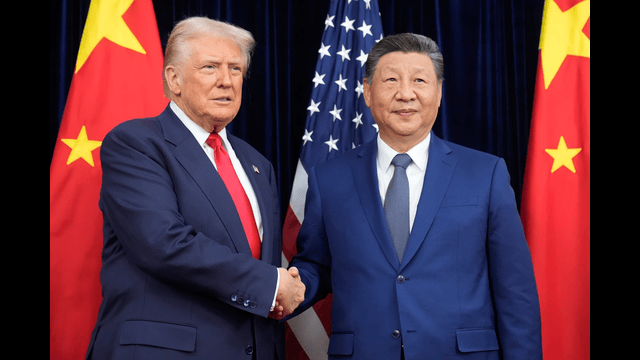
President Donald Trump, left, and Chinese President Xi Jinping shake hands before their meeting at Gimhae International Airport in Busan, South Korea, Thursday, Oct. 30, 2025.
U.S. President Donald Trump and Chinese President Xi Jinping met face-to-face on Thursday in Busan, South Korea, aiming to cool months of trade tension between the world’s two largest economies. The talks came amid escalating tariffs, rare earth export restrictions, and growing uncertainty in global markets.
Both leaders appeared optimistic. “We’re going to have a very successful meeting, I have no doubt,” Trump said as he shook Xi’s hand. Calling Xi a “very tough negotiator,” Trump hinted that a potential deal could emerge soon. Xi, reading prepared remarks, said both nations must accept differences but continue to cooperate. “It is normal for the two leading economies of the world to have frictions now and then,” he noted.
Trade Talks Gain Urgency
Trump’s return to the White House and renewed tariff policies reignited trade disputes with China. In response, Beijing limited exports of rare earth elements — critical for industries such as defense, energy, and electronics. With both economies feeling the strain, Thursday’s meeting was seen as an opportunity to stabilize relations before tensions spiral further.
U.S. officials hinted that Trump might hold back from imposing an additional 100% import tax on Chinese goods. Meanwhile, China has shown readiness to ease export restrictions and increase U.S. soybean imports, signaling a willingness to de-escalate.
Behind Closed Doors in Busan
The leaders met at 11:13 a.m. local time in a modest gray building near Busan’s international airport — a far cry from the luxury venues often used for major summits. Trump’s helicopter arrived just minutes before Xi’s Air China jet landed. Their discussion lasted about 100 minutes, ending with a brief handshake before both leaders departed.
Officials from both countries had met earlier in Kuala Lumpur to set the stage. China’s top trade negotiator, Li Chenggang, said they had reached a “preliminary consensus,” a sentiment echoed by U.S. Treasury Secretary Scott Bessent, who described the talks as “a very successful framework.”
Tariffs, Fentanyl, and Future Cooperation
En route to South Korea, Trump told reporters he may roll back tariffs related to China’s role in producing fentanyl, a powerful synthetic opioid fueling an epidemic in the U.S. “I expect to be lowering that because I believe they’re going to help us with the fentanyl situation,” he said, calling current U.S.-China relations “very good.”
On Truth Social, Trump dubbed the event the “G2” meeting — a nod to the economic dominance of the two nations. Markets reacted positively, with U.S. stocks rising on hopes that the meeting would lead to a concrete trade framework.
Pressure Points Remain Between the U.S. and China
Despite the warm gestures, deep divisions persist. Both nations continue to compete in manufacturing, artificial intelligence, and global influence. Trump avoided discussing sensitive issues like Taiwan’s security, focusing instead on immediate trade concerns.
“The proposed deal fits a familiar pattern — short-term stabilization dressed up as strategic progress,” said Craig Singleton of the Foundation for Defense of Democracies. He added that both sides were managing volatility rather than resolving core disputes.
For Trump, tariffs remain his key leverage. Earlier this year, he imposed new duties totaling 30%, including 20% tied to China’s alleged fentanyl role. Although he threatened a 145% tariff in April and a 100% import tax in October, both were later scaled back amid market concerns.
Xi, meanwhile, holds sway through China’s dominance in rare earth minerals — vital for high-tech manufacturing. His October export restrictions mirrored a recurring cycle: both nations escalating, then retreating, after renewed talks.
The Road Ahead for U.S.-China Relations
Following the meeting, Trump planned to return to Washington, while Xi stayed in South Korea for the Asia-Pacific Economic Cooperation (APEC) summit beginning Friday. Analysts believe Xi’s extended stay could strengthen China’s regional ties and counterbalance U.S. influence.
“Xi sees a chance to position China as a reliable partner,” said Jay Truesdale, CEO of TD International. “He’s looking to deepen ties with countries frustrated by U.S. tariffs.”
While the Busan meeting may not end the U.S.-China trade rivalry, it marks a tentative step toward easing economic strain — and possibly setting a new tone for global cooperation.