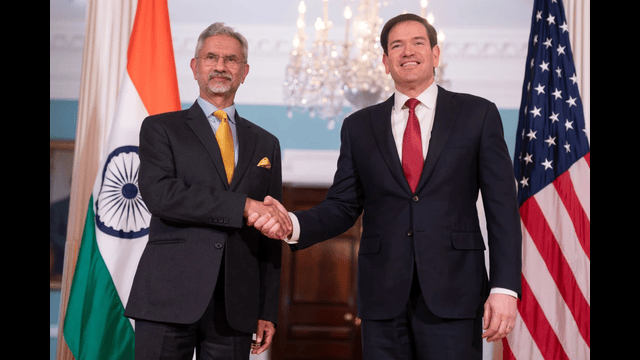
Secretary of State Marco Rubio, right, shakes hands with India’s External Affairs Minister Subramanyam Jaishankar.
The Trump administration is intensifying efforts to secure critical minerals beyond China’s control.
These minerals are essential for jet engines, smartphones, batteries, and defense systems.
Officials say the goal is supply security, not short-term trade advantage.
The strategy marks the administration’s most ambitious minerals plan yet.
A Major Shift in Critical Minerals Strategy
The White House plans large-scale purchase agreements with global partners.
It also aims to create a U.S. Strategic Critical Minerals Reserve.
The reserve could be worth nearly $12 billion.
It is designed to reduce dependence on China.
Vice President JD Vance will outline the strategy this week.
He is set to speak at a high-level international meeting.
Secretary of State Marco Rubio is hosting officials from Europe, Asia, and Africa.
Global Talks Gain Momentum
The meeting is expected to produce supply chain agreements.
These deals will focus on mining, processing, and logistics.
Specific terms have not yet been disclosed.
Earlier this week, Rubio met ministers from India and South Korea.
Their talks centered on critical minerals cooperation.
Both nations are seen as key partners.
Project Vault Takes Center Stage
The discussions follow Trump’s launch of “Project Vault.”
The initiative creates a national stockpile of critical minerals.
Funding includes a $10 billion loan from the Export-Import Bank.
Private investors are contributing nearly $1.67 billion.
Trump said the U.S. cannot repeat past shortages.
He cited last year’s supply disruptions as a warning.
Project Vault aims to prevent future shocks.
China’s Dominance Drives Urgency
China controls about 70% of global rare earth mining.
It handles nearly 90% of rare earth processing.
This dominance became a strategic risk during trade tensions.
China restricted rare earth exports during tariff disputes.
That move disrupted Western supply chains.
Although tensions eased after Trump met Xi Jinping, limits remain tight.
Buyers’ Club Concept Emerges
Industry leaders say the trade war changed global thinking.
Western nations now see their vulnerability clearly.
Some are considering joint purchasing strategies.
Mining executive Pini Althaus described a potential “buyers’ club.”
Producers and consumers could coordinate pricing and supply.
The idea aims to stabilize markets outside China’s influence.
Government Investment Accelerates
The U.S. government recently invested directly in domestic mining.
It extended $1.6 billion to USA Rare Earth.
The deal included equity and repayment terms.
Officials are closely scrutinizing companies before investing.
They expect reliable delivery and taxpayer returns.
Government funding now mirrors private equity standards.
Strategic Stockpile Takes Shape
The Export-Import Bank approved its largest loan ever.
The funds will help establish the minerals reserve.
Manufacturers like Boeing and GE Vernova are involved.
Bank leadership calls it a public-private solution.
Companies commit long-term funding.
Government loans unlock private capital.
Reshaping Prices Without China
Experts say the reserve could change market pricing.
China has historically undercut rivals with cheap supply.
A diversified market may support fairer prices.
Permanent magnet producers support the approach.
They say it encourages sustainable competition.
It also strengthens domestic manufacturing.
Pentagon Steps In
The Defense Department has invested nearly $5 billion recently.
Its goal is secure access to strategic materials.
Military readiness depends heavily on rare earth elements.
The trade war exposed defense vulnerabilities.
Pentagon funding now fills critical gaps.
Bipartisan Backing Builds
Lawmakers from both parties support the minerals push.
A new proposal calls for a $2.5 billion agency.
Its mission would boost rare earth production.
Senators praised the administration’s direction.
They said reducing reliance on China is essential.
Market stability is another priority.
Long Road Ahead
Experts caution that building reserves will take time.
Rare earth supplies remain tight globally.
China’s restrictions still affect availability.
Analysts also stress the need for downstream manufacturing.
Minerals alone cannot secure supply chains.
Domestic demand must also grow.
The administration’s minerals strategy is evolving.
Its success may define America’s industrial future.