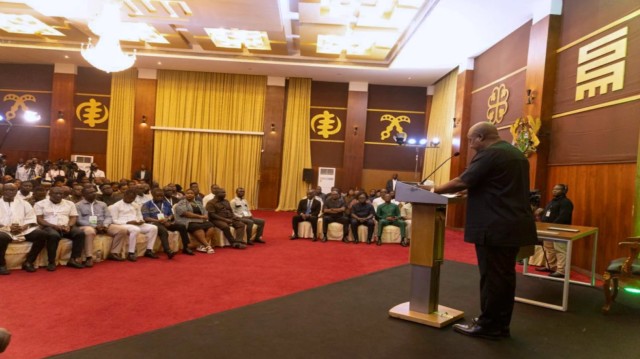
Ghana’s President John Mahama speaks to the media at the Jubilee House in Accra, Ghana, Wednesday, Sept. 10, 2025.
The United States has stepped up deportations of immigrants to African nations that are not their home countries. Ghana became the latest to receive such deportees, but questions remain about the legality and ethics of this approach.
Ghana Accepts Deportees on “Humanitarian Grounds”
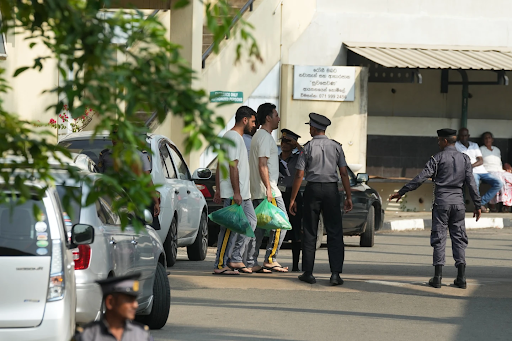
Last week, 14 immigrants deported from the U.S. arrived in Ghana. They included 13 Nigerians and one Gambian—none of whom were Ghanaian. According to Ghana’s Foreign Minister Samuel Okudzeto Ablakwa, the decision was taken “purely on humanitarian principle.”
Ablakwa explained that Ghana stepped in because other West African nations declined the request. “We just could not continue to take the suffering of our fellow West Africans,” he said.
Deportees Sent Without Clear Information
Court documents reveal the deportees were woken at night on September 5. They boarded a U.S. military cargo plane without being told their destination until hours into the flight.
Lawyers representing the men argue that the individuals had no ties to Ghana. Some had even obtained legal orders barring their return to their home countries due to safety concerns.
Contradicting Reports on Deportees’ Status
Ghana’s government initially announced that the 14 migrants had already left for their home countries. Officials said arrangements were made to transport the Nigerians by bus back to Nigeria. The journey typically takes about seven hours.
However, lawyers for at least four deportees insisted the men were still detained in Ghana as of Monday evening. The conflicting reports have not yet been reconciled.
Nigeria Criticizes Deportation Process
Nigerian authorities expressed shock at the development. Officials said they were not notified by either Ghana or the U.S. about the transfer. Nigeria clarified that it only rejects deportations of foreign nationals into its territory, not Nigerian citizens themselves.
“What we have only rejected is deportation of other nationals into Nigeria,” a spokesperson from Nigeria’s Ministry of Foreign Affairs stated.
African and Latin American Nations Face Similar Pressure
Ghana is not alone. Eswatini, Rwanda, and South Sudan have also taken in third-country deportees. Uganda has signed an agreement with the U.S. but has not yet received any.
Beyond Africa, several Latin American countries are part of similar deals. Hundreds of Venezuelans have been sent to El Salvador, while Costa Rica and Panama have received immigrants from Afghanistan, Russia, Iran, and China. Last month, Paraguay also signed a third-country agreement with the U.S.
Human Rights Concerns Over Deportation Program
The U.S. deportation strategy has drawn widespread criticism from human rights experts. Critics argue that asylum-seekers are not properly screened and may face grave danger upon removal.
One lawyer reported that deportees to Ghana endured “abysmal” detention conditions. They were allegedly restrained in straitjackets for 16 hours during the flight. Ghanaian officials denied knowledge of these claims.
Maureen A. Sweeney, an immigration lawyer and professor at the University of Maryland, said sending migrants back despite protective orders is a “clear violation” of international duties.
She added, “This is part of a pattern by the U.S. government of extreme indifference to human consequences.”
Growing Scrutiny on US Deportations to Africa
The deportations highlight the growing reliance on third-country agreements to reduce immigrant numbers in the U.S. But the practice raises troubling questions about legality, transparency, and respect for international human rights.
As more African and Latin American nations accept deportees, the debate is likely to intensify.