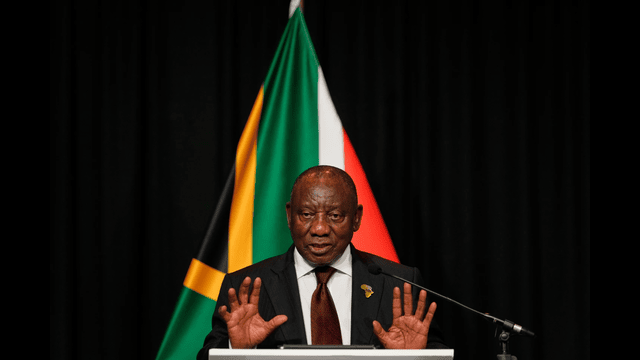
South African President Cyril Ramaphosa addresses the media with EU leaders in Johannesburg, South Africa, Thursday, Nov. 20, 2025.
The White House sharply criticized South African President Cyril Ramaphosa on Thursday for comments suggesting the United States reversed its decision to boycott the G20 summit in Johannesburg. The exchange added fresh strain to an already tense relationship between Washington and Pretoria.
U.S. Boycott Sparks a War of Words
Ramaphosa told reporters that the U.S. had changed its mind “at the 11th hour” and now sought to participate in some form.
But the White House pushed back. Press secretary Karoline Leavitt dismissed the claim and accused Ramaphosa of “running his mouth” about the U.S. and President Donald Trump.
Leavitt said the U.S. was only sending a diplomatic representative to observe the G20 presidency handover, not to join the summit’s discussions.
Washington Maintains Its Boycott
A White House official confirmed that the U.S. will not join any official meetings during the two-day summit. The official said an embassy representative would attend only the closing ceremony where South Africa hands over the rotating G20 presidency.
President Donald Trump had earlier announced a full boycott, claiming—without evidence—that South Africa was violently persecuting white Afrikaner farmers. His statements have been widely rejected by international observers.
Ramaphosa had previously expressed concern that the boycott would leave an “empty chair” during the handover, a symbolic blow for Africa’s first G20 presidency.
South Africa Welcomes Limited U.S. Presence
Despite the harsh rhetoric, Ramaphosa called the U.S. decision to attend the ceremony “pleasing.”
He emphasized that the G20 operates by inclusive principles, noting, “The United States is an original G20 member, so they have the right to be here.”
Ramaphosa said South Africa was working through “practicalities” to facilitate America’s limited participation despite the ongoing U.S. boycott.
Dispute Over the G20 Declaration
Tensions escalated further when Ramaphosa said the summit would issue a joint declaration—even after Washington advised against it.
A South African G20 official revealed that the U.S. had communicated it did not want a declaration adopted because the boycott meant there was “no consensus.”
Instead, Washington pushed for a scaled-down closing statement issued solely by South Africa.
But South Africa resisted the pressure. Ramaphosa said, “We will have a declaration. We will not be bullied.”
He added that negotiations were “going extremely well,” and leaders were finalizing the document.
Global Leaders React to the Standoff
Other world leaders expressed hope for a unified outcome despite the U.S. absence. German Chancellor Friedrich Merz said he was optimistic but admitted agreement was “not entirely certain.”
Several major leaders, including Xi Jinping, Vladimir Putin, and Javier Milei, also skipped the summit but sent delegations—making the U.S. the only G20 member not represented in the room for discussions.
South African G20 ambassador Xolisa Mabhongo noted the U.S. alone chose not to join the talks.
Trump’s Continued Criticism of South Africa
The diplomatic rift reflects a deeper pattern. President Trump has repeatedly targeted South Africa since returning to office.
Their May meeting at the White House was described as tense, with Trump confronting Ramaphosa over claims of anti-white policies—claims widely dismissed as baseless.
He has reiterated these accusations in the lead-up to the summit, fuelling ongoing friction between the two nations.
South Africa’s G20 Vision Takes Center Stage
Hosting the G20 for the first time, South Africa aims to highlight issues affecting developing nations. Its key priorities include:
- Addressing climate change impacts
- Reducing debt burdens on developing nations
- Tackling global wealth inequality
European Union leaders Ursula von der Leyen and António Costa voiced strong support for South Africa’s agenda during their meeting with Ramaphosa.
The U.S. has criticized these priorities, with Secretary of State Marco Rubio dismissing them earlier this year as focused on “diversity, equity, inclusion, and climate change”—an agenda he refused to fund.
A Summit Overshadowed by U.S. Absence
The G20 brings together the world’s largest developed and developing economies, making the U.S. boycott highly unusual.
Yet, South Africa insists the summit will move forward with consensus. “Without the United States, the whole process of the G20 is moving forward,” Ramaphosa declared.
Despite diplomatic tensions, leaders remain committed to delivering meaningful outcomes for the global south as the landmark summit gets underway in Johannesburg.