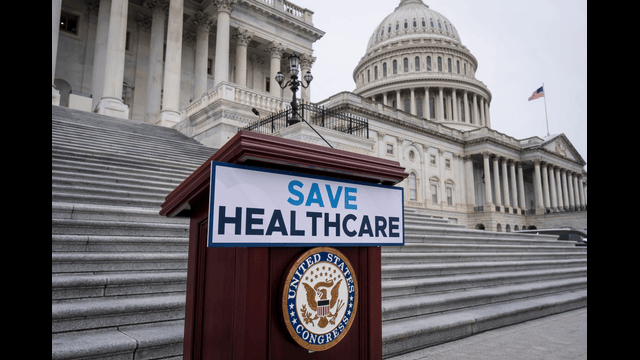
House democrats prepare to speak on the steps of the Capitol to insist the Republicans include an extension of expiring healthcare benefits as part of the government funding compromise.
The longest government shutdown in U.S. history is finally nearing an end after 43 tense days that left Americans angry and exhausted. The expected conclusion brings little satisfaction to either party — and none to the millions affected.
Democrats failed to secure the health insurance tax credit extension they fought for, while Republicans, who control Congress and the White House, are absorbing most of the public blame.
Shutdown Fallout Hits Americans Hard
The shutdown’s toll stretched far beyond Washington. Federal workers missed paychecks, causing widespread financial hardship. Airline passengers faced delays and cancellations, while the halted nutrition assistance program forced thousands to turn to food banks during the holiday season.
Economists estimate the nation lost $11 billion, some of which will never be recovered. The Congressional Budget Office warned that while the economy will bounce back partially, the human cost — stress, job uncertainty, and shaken confidence — will linger.
What Sparked the Shutdown
At the heart of the standoff was a Democratic demand to extend an enhanced health insurance tax credit. The credit, introduced during the pandemic and renewed under President Biden’s energy and health bill, was set to expire in December.
Without it, insurance premiums would double for millions, and over 2 million Americans could lose coverage entirely, according to the Congressional Budget Office.
Democratic leader Chuck Schumer argued that the situation would create a healthcare crisis. Republicans, led by Senate Majority Leader John Thune, refused to negotiate until a funding bill passed. Thune promised a December vote on the issue, but Democrats doubted the promise would hold.
The standoff echoed the 2013 shutdown, when Republicans tried to block the Affordable Care Act — and Schumer made the same argument then: “Open the government first, then we talk.”
Democrats Under Pressure
The shutdown came amid growing frustration within the Democratic Party over its inability to counter the Trump administration’s policies. Over 200,000 federal workers have left their jobs during President Trump’s second term, as several agencies were downsized or dismantled.
Schumer faced backlash from progressives after backing a 2025 funding bill earlier this year. Critics accused him of yielding to Republicans and demanded stronger opposition. This time, he insisted on bipartisan talks, citing Senate rules that require 60 votes to move spending bills forward.
But Republicans bypassed him, working instead with a handful of Democrats to advance a short-term funding deal. House Speaker Mike Johnson accused Schumer of “caving to radicals in his party” by refusing to cooperate.
The Political Blame Game
Both sides spent weeks trying to control the narrative. Polls suggest the public blames Trump and Republicans more, though Democrats aren’t escaping scrutiny.
An AP-NORC poll found that 60% of Americans hold Republicans “largely responsible,” while 54% say Democrats share “a fair amount” of blame. Nearly three-quarters believe both sides are at fault.
Recent state elections in Virginia and New Jersey offered clues about shifting public sentiment. Democrats saw strong results, while Trump acknowledged the shutdown was a “big negative” for Republicans. Still, the GOP refused to compromise, and Trump called for ending the Senate filibuster — a move that would let the majority pass laws without bipartisan support.
A Costly Lesson for Washington
The shutdown agreement, crafted by the Senate Appropriations Committee, will fund key areas such as veterans’ programs, food aid, and the legislative branch. The rest of the government will operate under a temporary funding extension until January, giving lawmakers two more months to finish negotiations.
While the deal ends the impasse, it offers no clear victory — only exhaustion. Federal workers will finally receive back pay, but the damage to public trust remains.
Senator Jerry Moran summed up the sentiment best: “This dysfunction not only hurts Americans at home but also weakens our standing abroad.”
After 43 days, the historic shutdown ends with no winners — only lessons about division, accountability, and the cost of political brinkmanship.