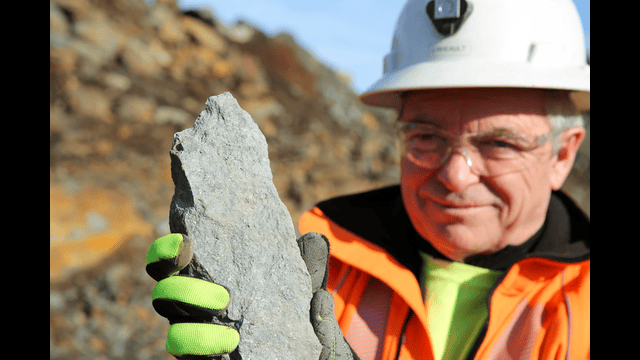
Joel Rheault, vice president of operations for Titan Mining Corp, holds a rock containing graphite at a mine, Nov, 20, 2025.
Graphite mining in the United States is drawing renewed attention after decades of decline. Once considered unnecessary due to cheap imports, the mineral is now central to America’s clean energy and supply chain goals. Rising demand from the battery boom and growing trade tensions with China are reshaping the conversation.
Why Graphite Matters More Than Ever
Graphite is a core ingredient in lithium-ion batteries, which power phones, electric vehicles, and energy grids. It also plays a role in nuclear reactors, industrial lubricants, and military equipment.
As electric vehicle adoption accelerates, graphite demand is surging worldwide. Analysts expect this trend to continue well into the next decade.
China’s Grip Raises Supply Chain Fears
For years, the United States relied heavily on imported graphite, mainly from China. China dominates both natural and synthetic graphite production.
That dominance has alarmed U.S. policymakers. Concerns grew after China imposed export controls on graphite and other minerals, later easing them temporarily.
Federal officials now view graphite as a critical mineral, essential for national security and economic stability.
New York Project Signals Shift
In northern New York, Titan Mining Corp. is reviving domestic graphite production. The company has begun limited mining near the Canadian border, with plans for commercial sales by 2028.
Executives believe geopolitical changes favor U.S.-based graphite mining. The company aims to serve industrial, energy, and military markets.
“We see a real opportunity,” said CEO Rita Adiani. “China is no longer a reliable supply partner.”
A Region With Mining Roots
The New York deposit sits in a rural area known for historic graphite and iron mining. The famous Ticonderoga pencil was named after a nearby town tied to early graphite production.
Titan’s site was identified within an existing zinc mine, allowing early graphite extraction under current permits.
What Makes Graphite Critical
Graphite conducts electricity and withstands extreme heat. These properties make it vital for battery anodes and high-temperature industrial uses.
The Department of Energy and the Department classify graphite as a critical mineral. Federal officials warn that shortages could disrupt energy and defense systems.
Federal Support Accelerates Projects
The U.S. government is backing graphite mining through tax credits and faster permitting. The Inflation Reduction Act includes incentives for domestic critical mineral production.
Titan’s New York project received fast-track approval this fall. The Export-Import Bank may provide up to $120 million in financing and already pledged funds for feasibility studies.
More Graphite Projects Emerge
According to the U.S. Geological Survey, the country currently has no commercial graphite mines. However, five projects are active.
These include sites in Alabama, Montana, Alaska, and New York. Alaska hosts what officials call the nation’s largest known graphite deposit.
“There’s no reason to rely on China,” said Anthony Huston, CEO of Graphite One.
Production Could Transform Supply
Titan expects to produce 40,000 metric tonnes of graphite concentrate annually. That could supply nearly half of current U.S. natural graphite demand.
Company leaders say buyer interest is strong and could absorb the entire output.
A Strategic Comeback
Graphite mining in the US is no longer a relic of the past. Driven by the battery boom and supply chain security, domestic production is gaining urgency.
As demand rises, graphite may become one of America’s most strategic minerals again.