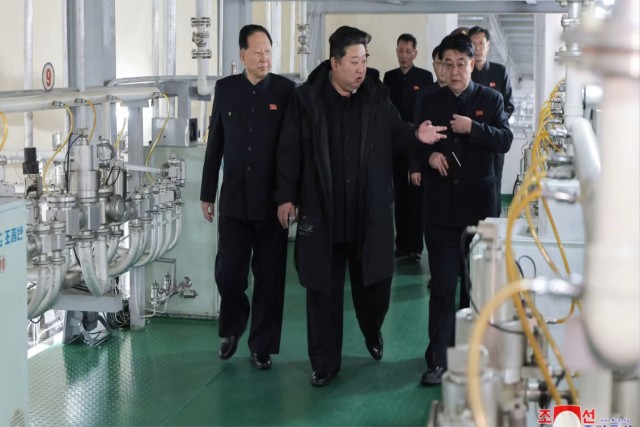
North Korean leader Kim Jong Un visits the country's nuclear material production base and nuclear weapons institute in this photo released by North Korea's official Korean Central News Agency on January 29.
The recent US airstrike on Iran’s nuclear sites has sent shockwaves far beyond the Middle East. In East Asia, experts believe the move could have dangerous ripple effects. Most notably, it may push North Korea to strengthen its nuclear arsenal rather than seek disarmament.
This development follows President Trump’s decision to launch B-2 bombers against Iranian nuclear facilities. While aimed at curbing Tehran’s nuclear ambitions, the strike might unintentionally reaffirm Pyongyang’s belief in nuclear weapons as the ultimate defense against regime change.
Nuclear Strike on Iran Sends Chilling Message to North Korea
North Korea has long viewed nuclear weapons as its main shield. The recent US airstrike, many analysts say, only solidifies that belief.
According to Lim Eul-chul, a North Korean studies professor at Kyungnam University, “Trump’s attack on Iran reinforces North Korea’s commitment to its nuclear policy.” Pyongyang sees the strike as a sign that Washington may resort to preemptive military action. In response, it could quicken efforts to enhance its nuclear strike capability.
Growing Ties With Russia Could Boost North Korea’s Arsenal
One of the most alarming possibilities is that North Korea may turn to Russia for help. Since 2024, Pyongyang has developed a close military alliance with Moscow. This strategic partnership emerged as a lifeline during harsh Western sanctions.
Lim warns that this alliance could lead to joint weapons development, combined drills, and advanced technology transfers. In return for military aid to Russia—over 14,000 North Korean troops and millions of munitions—Pyongyang has received vital defense equipment and refined oil.
A UN Multilateral Sanctions Monitoring Team report noted that Russia’s support gives North Korea both resources and modern combat experience. This support enhances its banned ballistic missile programs and accelerates nuclear advancements.
A History of Nuclear Defiance
North Korea’s nuclear ambition is not new. It has conducted six nuclear tests since 2006, most under Kim Jong Un’s leadership. Each test underscored Pyongyang’s intent to defy international pressure.
Experts believe the US strike on Iran could serve as another warning for Kim. Victor Cha, a senior expert on Korean affairs, said the message is clear: “Nations without nuclear weapons—like Iraq, Libya, and Iran—are vulnerable to US strikes. North Korea will not make the same mistake.”
Pyongyang’s Nukes Are More Advanced Than Iran’s
The difference between North Korea and Iran is stark. North Korea already has an estimated 40–50 nuclear warheads. It also possesses multiple delivery systems, including intercontinental ballistic missiles (ICBMs) capable of reaching the US mainland.
Leif-Eric Easley, an international security professor in Seoul, highlighted this key point. “North Korea can strike both South Korea and the US homeland,” he said. Iran, by contrast, hasn’t crossed the threshold into weaponization and still engages in diplomatic talks with the West.

Military Action on the Korean Peninsula Is Far Riskier
A direct strike on North Korea would come with massive risks. Unlike Iran, Pyongyang has a formal mutual defense pact with Russia. This means Russia could intervene militarily if North Korea is attacked.
Additionally, the US-South Korea alliance treaty requires Washington to consult Seoul before any military action. Such constraints reduce the likelihood of a unilateral strike like the one seen in Iran.
Lim points out that this mix of nuclear capability, Russian backing, and alliance treaties makes North Korea a much more difficult target.
A Trigger for Greater Nuclear Determination
Instead of discouraging nuclear proliferation, Trump’s action might inspire it. Lim concludes, “The attack will only deepen Pyongyang’s distrust of the US. It may trigger an even stronger alignment with Russia.”
With the stakes higher than ever, the message North Korea takes from Iran’s strike is this: Nuclear weapons are not just protection—they are survival.