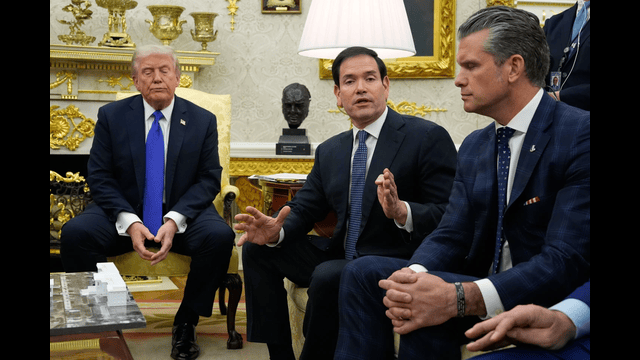
President Donald Trump and Defense Secretary Pete Hegseth listen as Secretary of State Marco Rubio speaks during a meeting with NATO Secretary General Mark Rutte in the Oval Office of the White House, Wednesday, Oct. 22, 2025, in Washington.
The United States military has widened its anti-drug campaign beyond the Caribbean, striking two more alleged drug-carrying boats in the Pacific Ocean this week. Defense Secretary Pete Hegseth confirmed the attacks, which left five people dead, as part of the Trump administration’s growing offensive against drug cartels in South America.
Ninth Strike Marks Shift in Target Zone
According to Hegseth, Wednesday’s strike in the eastern Pacific killed three people aboard a suspected narcotics vessel. It followed another attack on Tuesday night in the same region that killed two.
These are the first Pacific operations after seven earlier strikes in the Caribbean Sea. The expanding target zone highlights Washington’s renewed focus on the ocean routes used for cocaine smuggling from South America.
The latest attacks have raised the death toll to at least 37 since the campaign began last month.
Hegseth Compares Cartels to Terrorists
In a series of social media posts, Hegseth drew parallels between the Trump administration’s war on drug traffickers and the post-9/11 war on terror.
“Just as Al Qaeda waged war on our homeland, these cartels are waging war on our people,” he said. “There will be no refuge or forgiveness — only justice.”
He later referred to the drug cartels as “the Al Qaeda of our hemisphere,” emphasizing the administration’s intent to treat drug smugglers as enemy combatants.
Trump Cites Legal Authority, Signals More Strikes Ahead
President Donald Trump defended the operations, claiming they fall under existing legal authority. Speaking from the Oval Office alongside NATO Secretary General Mark Rutte, he said, “We have legal authority. We’re allowed to do that.”
Trump also hinted at possible land-based strikes, adding, “We will hit them very hard when they come in by land. We’re totally prepared for that.”
The president argued that such actions are necessary to save American lives, saying each destroyed drug boat prevents thousands of overdose deaths.
Secretary Rubio Defends Military Action
Secretary of State Marco Rubio backed Trump’s stance, insisting that the U.S. is justified in its response.
“If people want to stop seeing drug boats blow up, stop sending drugs to the United States,” Rubio said during the meeting.
The administration maintains that its strikes target vessels carrying cocaine and fentanyl intended for U.S. markets. Officials claim these efforts are crucial to curbing the ongoing opioid crisis.
Cocaine Routes and Regional Tensions
Video clips released by Hegseth show boats laden with packages before erupting in explosions. The eastern Pacific, where the attacks took place, is a major corridor for cocaine trafficking.
Countries like Colombia and Peru — the world’s largest cocaine producers — ship much of their product through these waters, often using Ecuador’s ports as transit hubs.
Washington has increased its military presence near Venezuela and along the Pacific routes, sparking speculation of broader regional objectives. Venezuelan President Nicolás Maduro, already facing U.S. narcoterrorism charges, has condemned earlier strikes.
Questions Over Legal and Ethical Grounds
While the Trump administration insists it is fighting an “armed conflict” against cartels, critics say the strikes raise legal and moral concerns.
Democratic lawmakers argue that Trump has bypassed Congress, violating U.S. and international law.
Senator Richard Blumenthal criticized the administration’s lack of transparency, saying, “Expanding the geography simply expands the lawlessness and recklessness in using American military power.”
He added that instead of destroying vessels, authorities should intercept them and question suspects to trace drug networks.
Political Divide Deepens
Congress remains split over the issue. A Democratic-led war powers resolution requiring Trump to seek congressional approval for further strikes was recently voted down by the Republican majority.
Senator John Kennedy defended the administration, saying he trusts Rubio’s legal reasoning and calling the actions justified against “narcoterrorists.”
As Washington’s campaign shifts from the Caribbean to the Pacific, questions grow about how far the U.S. will go in its war on drugs — and whether the line between counter-narcotics operations and undeclared warfare is beginning to blur.