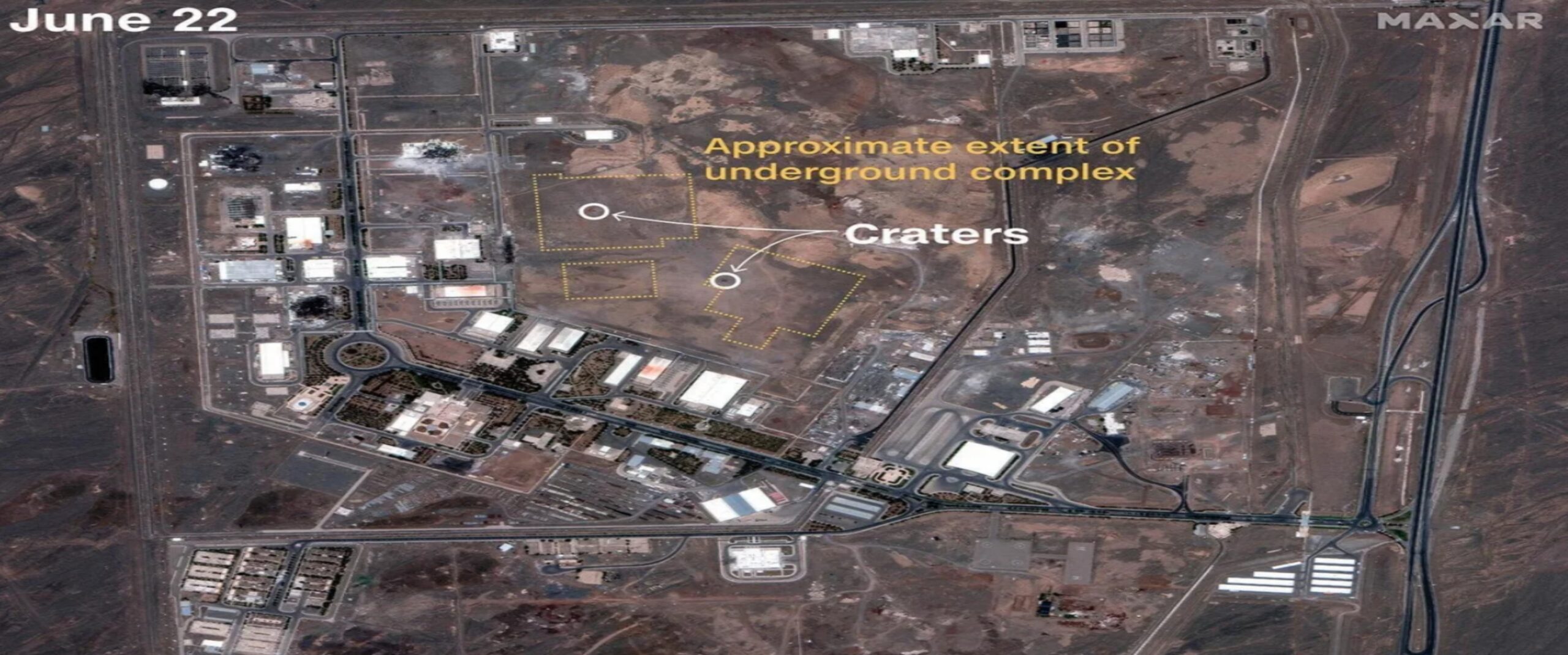
A satellite image shows two craters above underground halls at the Natanz Nuclear Facility after the site was bombed by the United States on June 22.
The United States has taken a bold and forceful step in the growing Iran-Israel conflict. On Saturday night, President Donald Trump confirmed that US forces struck three major Iranian nuclear sites—Fordow, Natanz, and Isfahan. This military move marks a significant shift from prior diplomatic efforts.
While Trump claimed the strikes “obliterated” Iran’s nuclear program, Iranian officials offered mixed responses. As satellite images begin to surface, experts are analyzing just how effective the strikes have been.
Massive Strike Hits Fordow: The Heart of Iran's Nuclear Enrichment
Fordow is Iran’s most fortified nuclear site, located deep within a mountain near the city of Qom. The facility lies nearly 90 meters underground, making it difficult to reach using standard munitions. However, the US deployed six B-2 stealth bombers to deliver twelve 30,000-pound GBU-57 bunker-busting bombs—designed specifically for such hardened targets.
Satellite imagery from Maxar revealed six large impact craters along the mountain ridge. Experts suggest the irregular craters indicate that multiple bombs hit the same locations repeatedly, maximizing the damage.
Rafael Grossi, chief of the International Atomic Energy Agency (IAEA), confirmed a “direct kinetic impact” but said it was too early to determine the full internal destruction. David Albright, head of the Institute for Science and International Security, suggested there could be “considerable damage” inside the facility.
Though Iranian lawmaker Manan Raeisi claimed the strike had only superficial effects, analysts are skeptical. History shows Iran has often downplayed the consequences of attacks on its nuclear program.
Natanz Struck Again: Underground Centrifuges Possibly Affected
Natanz, Iran’s largest uranium enrichment facility, was hit in an earlier Israeli strike on June 13. That initial attack reportedly damaged above-ground power infrastructure. On Saturday, the US launched another round of strikes, using B-2 bombers and Tomahawk cruise missiles.
New satellite images show two fresh craters at the site—one over five meters wide—directly above underground sections. Although the actual impact on underground centrifuges is still uncertain, damage to power systems could disrupt uranium enrichment.
The site contains key infrastructure such as cascade halls, which house centrifuges used to refine uranium. Disruption at this level could delay Iran’s nuclear progress significantly.
Isfahan in Ruins: Key Research Facility Faces Severe Destruction
Isfahan, located in central Iran, is home to the country’s largest nuclear research complex. The site, built with Chinese support in the 1980s, employs thousands of scientists and plays a vital role in Iran’s nuclear operations.
The US assault left at least 18 structures destroyed or heavily damaged. The main uranium conversion facility was reportedly “severely damaged,” according to an assessment by the Institute for Science and International Security.
Three of four tunnel entrances leading into the complex appear to have collapsed. Satellite images also show the entrances were backfilled with soil prior to the strike—likely a safety measure to prevent radioactive leaks or explosions.
Pentagon officials confirmed that US Navy submarines launched more than a dozen Tomahawk missiles targeting Isfahan’s surface infrastructure. If reports about nearby tunnel complexes are accurate, the US may have aimed to destroy Iran’s enriched uranium stockpiles as well.
What the Strikes Mean for Iran’s Nuclear Future
The use of bunker-busting bombs and coordinated cruise missile attacks shows the US was targeting deeply buried nuclear assets, not just surface buildings. Analysts say this marks one of the most significant blows to Iran’s nuclear capabilities in recent years.
However, full verification will take time. The IAEA is still assessing the situation, and Iranian officials continue to downplay the damage. What’s clear is that the US has demonstrated its unmatched ability to hit deeply fortified nuclear targets, especially at Fordow, a site once thought impenetrable.
Conclusion
The US airstrikes on Iran’s nuclear facilities—Fordow, Natanz, and Isfahan—represent a decisive moment in Middle East tensions. While Iran downplays the damage, satellite evidence and expert analysis suggest otherwise. The long-term effects on Iran’s nuclear ambitions remain to be seen, but the scale and precision of the US attack send a clear message: no site is out of reach.