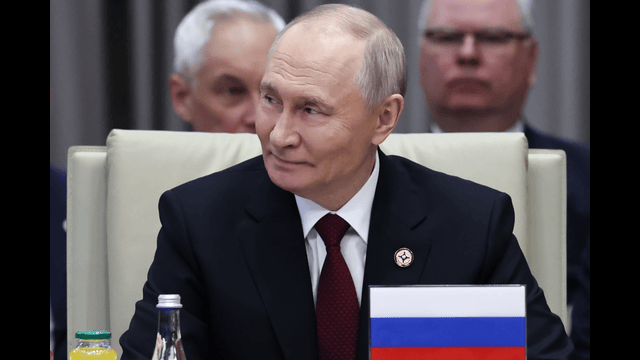
Russian President Vladimir Putin attends the summit of the Collective Security Treaty Organisation (CSTO) at the Administrative complex Yntymak-Manas Ordo, in Bishkek, Kyrgyzstan, Thursday, Nov. 27, 2025.
Russian President Vladimir Putin signaled a rare opening for talks on Thursday, calling the latest U.S. peace plan a possible starting point to end the Russia-Ukraine war. Yet he paired the message with a stark warning: Ukrainian forces must withdraw from occupied territories or face Russian military force.
Putin’s comments came at the close of his three-day trip to Kyrgyzstan, where he urged renewed diplomacy but insisted that “every word matters” in any negotiation effort.
US Peace Plan Seen as an Opening, Not an Agreement
Putin described President Donald Trump’s proposal as a list of ideas, not a finalized deal. He said Russia was prepared to “sit down and discuss this seriously,” but repeated that any cease-fire depended on Ukraine retreating from regions claimed by Moscow.
The Russian leader made it clear that failure to withdraw would trigger further military action. The Kremlin has remained largely silent on the U.S. plan, introduced last week, even as Washington pushes for rapid progress.
Russia’s Demands Remain Firm
Putin has long insisted that Ukraine must leave Donetsk, Luhansk, Kherson, and Zaporizhia—including areas Russia does not fully control—before talks can begin. He also wants guarantees blocking Ukraine from joining NATO or hosting Western troops.
These conditions would place Ukraine back under Moscow’s influence, which Kyiv and its allies strongly oppose.
Next week, U.S. envoy Steve Witkoff will head to Moscow, while U.S. Army Secretary Dan Driscoll, a key figure in recent peace efforts, may travel to Kyiv. Discussions between American and Ukrainian officials in Geneva earlier this week produced an amended peace proposal that balances earlier Russian-leaning terms.
European leaders, left out of key talks, are pushing to join the negotiations amid intensifying security fears.
Analysts: Putin Aims to Outlast Western Support
Experts note that Putin is trying to wear down Western resolve. Trump has hinted he may step back from mediation if progress stalls, a signal the Kremlin may be hoping to exploit.
European officials believe Russia is stalling intentionally to seize more territory before signing any settlement.
Despite its claims of battlefield momentum, Russia’s advance has been slow and costly. The Institute for the Study of War cast doubt on Moscow’s narrative this week. It said Russia’s push in eastern Donetsk remains stalled and that recent gains were driven by temporary weather conditions, not strategic superiority.
Rising Diplomatic Tensions With Europe
Hostility between Russia and Europe deepened Thursday as Moscow ordered the closure of Poland’s Consulate General in Irkutsk. The move came after Poland shut Russia’s consulate in Gdansk following a sabotage incident near Warsaw.
Polish officials suspect two Ukrainian nationals working for Russia in the railway attack, prompting a sharp diplomatic exchange.
Moscow warned it would not allow Polish actions to “go unanswered.”
Drone Warfare Intensifies on Both Sides
While diplomats exchange warnings, the war continues on multiple fronts.
A Russian drone attack killed a 53-year-old man in Ukraine’s Sumy region, officials said Friday. Russia also struck Odesa and Dnipropetrovsk, injuring at least three people and sparking large fires.
Ukraine’s air force reported intercepting many of the 142 drones launched overnight by Russian forces.
Russia, meanwhile, claimed it shot down 118 Ukrainian drones over the Black Sea and several Russian regions.
Ukraine Faces Internal Strain Amid Corruption Scandal
Ukraine’s challenges extend beyond the battlefield. President Volodymyr Zelenskyy’s government is grappling with a major corruption scandal and severe financial constraints.
The International Monetary Fund approved $8.1 billion in support over four years, providing temporary relief. But Ukraine’s projected military and national budget needs for 2026–2027 stand at a staggering $153 billion.
What Comes Next in the Russia-Ukraine War?
Putin’s acknowledgment of the U.S. peace plan adds a new dimension to stalled diplomacy. But his conditions remain firm, and Ukraine refuses to concede territory or abandon NATO ambitions.
With drone strikes rising, diplomatic tensions sharpening, and financial pressures mounting, the path to peace remains deeply uncertain—even as global powers push for movement.