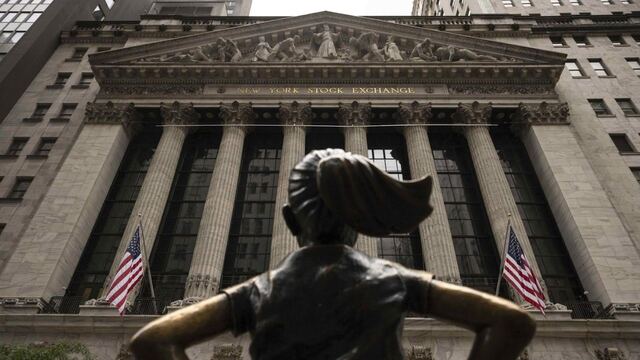
The "Fearless Girl" statue is seen outside the New York Stock Exchange on Wednesday, June 18, 2025, in New York. (Photo by Yuki Iwamura/AP)
After a midweek break for the Juneteenth holiday, U.S. stock markets ended Friday with modest and mixed results. Investors stayed cautious as global tensions, inflation worries, and shifting economic conditions continued to weigh on Wall Street.
The S&P 500 slipped 0.2%, marking its second week in a row of small losses. The Nasdaq composite dropped 0.5%, while the Dow Jones Industrial Average managed a small gain of 35 points, or 0.1%.
This quieter trading session followed a turbulent week in global markets. One of the biggest drivers of uncertainty is the escalating conflict involving Israel and Iran. President Donald Trump stated he would decide within two weeks whether the U.S. military would get involved. This standoff has kept traders nervous, especially since Iran plays a vital role in global oil supply and controls the key Strait of Hormuz, a major route for international oil shipments.
Because of this tension, oil prices have been swinging wildly, and with them, stock prices have followed suit. Fear of a possible disruption in crude supply has rattled market confidence throughout the week.
Brian Jacobsen, chief economist at Annex Wealth Management, summed up the market mood: “We’re all waiting on pins and needles to see what happens with the Israel-Iran situation.” He also added that sometimes the best response is to stay put and not make sudden trades based on short-term news.
Retail Sector Surprises Wall Street
Amid the market’s uncertainty, a few companies managed to shine. Grocery giant Kroger surged 9.8% after delivering better-than-expected quarterly profits. The company also raised its full-year revenue forecast, though it noted the economy remains unpredictable.
CarMax, a major used car dealer, climbed 6.6%. It reported a solid quarter, with nearly 6% more used cars sold compared to the same time last year, giving investors a reason to smile.
However, it wasn’t good news across the board. Smith & Wesson Brands, the firearms manufacturer, plunged nearly 20%. Its latest earnings fell just short of expectations. CFO Deana McPherson blamed the slump on “persistent inflation, high interest rates, and uncertainty caused by tariff concerns.” The company expects no major change in demand unless inflation eases or tariffs shift.
Tariffs Cloud 2025 Outlook
Across industries, many companies are revising or withdrawing their 2025 financial forecasts, largely because of confusion around U.S. tariff policy. Businesses are anxious to see if Trump will strike trade deals that might reduce or eliminate tariffs. These policies have a huge impact on pricing and supply chains, leaving companies and customers alike in limbo.
Even the Federal Reserve is waiting to see how it all plays out. The central bank has held off on raising interest rates again, wanting more economic data to determine how tariffs are affecting inflation and growth.
Bond Market Remains Steady
In the bond market, yields didn’t move much. The 10-year Treasury yield slightly dipped from 4.38% to 4.37%, and the 2-year yield, which closely tracks Fed rate expectations, fell from 3.94% to 3.90%.
International Markets Show Mixed Signals
Globally, stock indexes painted a mixed picture. Japan’s Nikkei 225 slipped 0.2% after May inflation, excluding food prices, rose to 3.7%. That puts more pressure on Japan’s government and central bank to manage the growing cost of living.