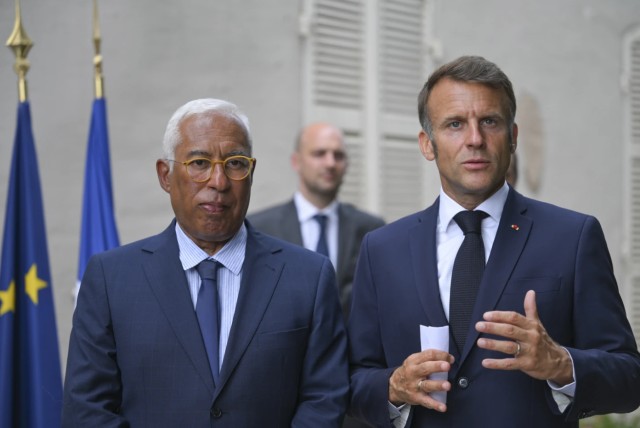
French President Emmanuel Macron, right, and Antonio Costa, President of the European Council, attend a statement following a video conference on Ukraine at the Fort de Bregancon in Bromes-les-Mimsas, southern France, Wednesday, August 13, 2025.
European leaders have welcomed President Donald Trump’s willingness to provide U.S. military support for a future peace force in Ukraine. The move is seen as a major step toward strengthening Ukraine’s security and discouraging Russian aggression.
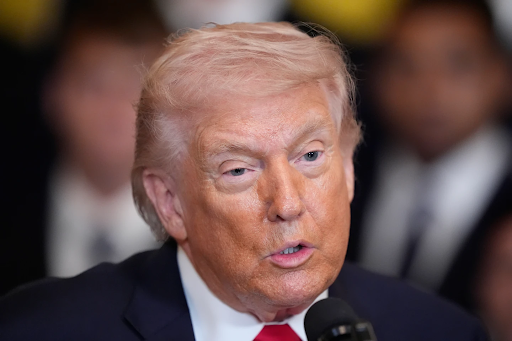
European officials revealed that Trump signaled support during a recent call ahead of his summit with Russian President Vladimir Putin. While no details have been shared publicly, the commitment has raised optimism about the success of the mission.
A Crucial Step for Ukraine’s Security
The coalition planning the initiative includes about 30 countries. Its effectiveness depends on strong deterrence, especially U.S. airpower. European militaries lack such capabilities in sufficient numbers, making American involvement essential.
Importantly, no U.S. ground troops will be deployed. However, the possibility of American air support significantly raises the credibility of the European-led force.
European Leaders Applaud Trump’s Move
European Council President Antonio Costa praised Washington’s “readiness to share Europe’s efforts” toward securing a lasting peace in Ukraine. French President Emmanuel Macron added that while NATO will not take part, the United States and partner nations are expected to contribute.
Although Trump has not confirmed details, European leaders say the assurance clarifies U.S. intent. Vice President JD Vance also attended the coalition meeting for the first time, underlining Washington’s engagement.
What is the Multinational Force Ukraine?
The planned mission, called Multinational Force Ukraine, has been months in the making. More than 200 planners, along with Ukrainian forces and British military personnel, have worked on strategies for post-war stability.
The proposed force could number between 10,000 and 30,000 troops. Its role will be to deter Russia, support Ukraine’s defenses, and protect air and sea routes.
According to U.K. Defense Secretary John Healey, the force will enhance Ukraine’s land defenses, secure skies with aircraft, and strengthen the Black Sea Task Force. Bulgaria, Romania, and Turkey are already cooperating on naval security in the region.
The mission will initially be headquartered in Paris before shifting to London. A Kyiv-based office will coordinate operations once hostilities end.
Russia’s Rejection
Moscow has firmly opposed the idea of European peacekeepers. Foreign Minister Sergey Lavrov said their presence would be “unacceptable” to Russia, comparing it to Ukraine joining NATO.
Lavrov argued that the force, even under an EU flag, would still represent NATO countries and pose a direct threat to Russia. This stance reflects Moscow’s longstanding resistance to Western-backed security guarantees for Ukraine.
Divisions Among European Allies
Despite progress, not all European nations are on board. Greece has declined participation, calling the discussions divisive. Italy also ruled out sending troops, though Prime Minister Giorgia Meloni stressed the importance of U.S. involvement.
Some countries fear that deploying forces may prolong conflict instead of hastening peace. Others view the mission as Europe’s first true test of self-defense capabilities after decades of relying heavily on U.S. power.
Why U.S. Support Matters
The presence of U.S. backing, even without troops, is critical. American military resources provide deterrence that Europe alone cannot guarantee. The threat of U.S. airpower would make Russia think twice about challenging the force.
Still, questions remain. Trump has shifted positions before, leaving uncertainty over the scope of support. Details of U.S. contributions remain unclear, and some allies are cautious about fully committing.
Ukraine’s Security Future
Ukraine has long sought NATO membership as its strongest security guarantee. But the Trump administration dismissed that option earlier this year, reflecting concerns that it could escalate tensions with nuclear-armed Russia.
For now, the Multinational Force Ukraine represents the most viable path to long-term stability. With American backing, Europe’s plan gains both credibility and deterrence. Without it, the mission risks faltering before deployment.