

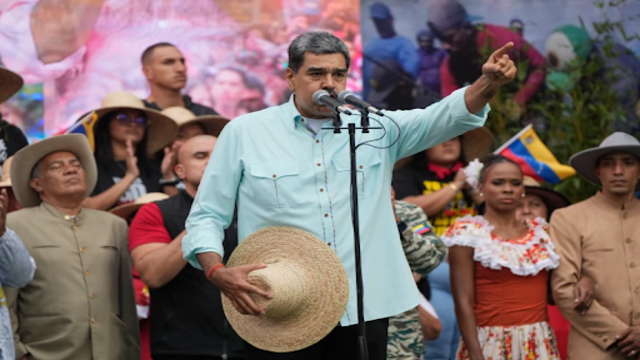
Nicolas Maduro speaks at a rally marking the anniversary of the Battle of Santa Ines, which took place during Venezuela’s 19th-century Federal War, in Caracas, Venezuela, Wednesday, Dec. 10, 2025. Associated Press
The United States has seized a large oil tanker off the coast of Venezuela, escalating tensions with President Nicolás Maduro’s government. President Donald Trump announced the seizure on Wednesday, marking one of the most aggressive U.S. actions in the region in years.
A Rare and Unusual Operation
Using U.S. forces to take control of a merchant ship is extremely uncommon. The move signals Washington’s growing pressure campaign on Maduro, who faces U.S. narcoterrorism charges.
Trump called the seized vessel “the largest one ever taken,” though he declined to provide further details. When asked about the oil on board, he simply responded, “We keep it, I guess.”
U.S. officials confirmed the operation was conducted under law enforcement authority, led by the Coast Guard with support from the Navy.
How the Oil Tanker Was Seized
The oil tanker, identified as the Skipper, was intercepted in a coordinated operation involving the aircraft carrier USS Gerald R. Ford. Coast Guard personnel were transported by helicopter and fast-roped onto the ship in a dramatic boarding captured on video.
In the footage, Coast Guard members move through the tanker’s superstructure with weapons drawn. Attorney General Pam Bondi posted the video, saying the ship had been sanctioned for years for moving illicit oil tied to foreign terrorist groups.
Venezuela condemned the action, calling it “international piracy” and accusing the U.S. of targeting the country’s natural resources.
What the Skipper Was Carrying
Documents from state-owned PDVSA show that the Skipper left Venezuela on Dec. 2 carrying 2 million barrels of heavy crude oil. Half of that load belonged to a Cuban state-run importer.
The Skipper previously operated under the name M/T Adisa, a vessel sanctioned in 2022 for participating in a secretive oil-smuggling network linked to Iran’s Revolutionary Guard and Hezbollah.
The network was allegedly run by a Switzerland-based Ukrainian oil trader, according to the U.S. Treasury Department.
Targeting Venezuela’s Sanctioned Oil Industry
Venezuela holds the world’s largest proven oil reserves, producing around 1 million barrels per day. PDVSA remains the backbone of its struggling economy.
But U.S. sanctions—especially those expanded in 2020—have cut off many of Venezuela’s traditional buyers. To bypass restrictions, the country increasingly relies on intermediaries, shell companies, and “ghost tankers” that conceal their locations and conduct ship-to-ship transfers in remote waters.
Both Russia and Iran have helped Maduro continue exporting oil despite U.S. pressure.
Venezuela Responds With Defiance
Maduro avoided directly addressing the tanker seizure during a rally in Caracas. However, he told supporters that Venezuela was ready to “break the teeth of the North American empire if necessary.”
He also reiterated his claim that U.S. military operations aim to remove him from power.
Critics in the U.S. Call It Regime-Change Strategy
The tanker seizure has intensified scrutiny of the Trump administration’s military actions in the region.
Sen. Chris Van Hollen argued that the operation undermines claims that the U.S. presence is focused on drug interdiction. He said the move proves the real intention is “regime change — by force.”
Naval historian Vincent P. O’Hara described the operation as “very unusual” and “provocative.” He warned that such actions could frighten away maritime traffic, crippling Venezuela’s already fragile economy.
Military Buildup and Rising Concerns
The seizure came just one day after U.S. fighter jets flew extremely close to Venezuelan airspace. Trump has repeatedly said that land attacks may follow, though he has offered no specifics.
The administration is also under fire for a series of deadly boat strikes targeting alleged smuggling vessels in the Caribbean and eastern Pacific. At least 87 people have been killed since September, including two survivors hit by a follow-up strike while clinging to wreckage.
Some lawmakers and legal experts say these strikes may violate rules governing military force. Congress is demanding unedited footage, but Defense Secretary Pete Hegseth is still weighing whether to release it.
The Coast Guard referred all questions about the tanker seizure to the White House.













