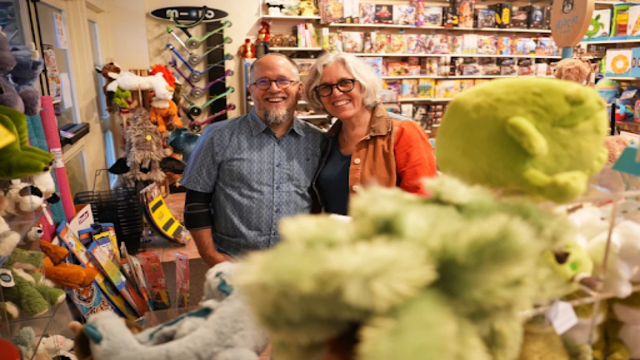
Co-owners Dean Smith, left, and Joanne Farrugia pose for a photograph in JaZams, one of their toy stores Friday, June 27, 2025, in Princeton, N.J. Associated Press
Every winter, the Ah Louis Store in San Luis Obispo transforms into a festive landmark. Garlands, nutcrackers, and ornaments fill the historic storefront by early November. The goal stays simple. Spread holiday joy across downtown.
Inside, shoppers browse hundreds of ornaments and curated gift baskets. But this season feels different. Higher costs and cautious customers have changed buying behavior.
Co-owner Emily Butler says tariffs reshaped how the store prepared for the holidays. Many decorations come from overseas suppliers. Some shipments arrived late. Others became too expensive to stock.
To protect margins, the store emphasized higher-value items. Nutcrackers and gift baskets took priority. Shoppers also adjusted. Many chose smaller baskets or fewer ornaments.
“We’re seeing more careful spending,” Butler said.
Tariffs and Confidence Hit Holiday Budgets
Unpredictable US tariffs are only part of the story. Inflation remains stubborn. Hiring growth has slowed. Together, they weakened consumer confidence.
A December AP-NORC poll found most Americans noticed higher prices. Groceries, electricity, and holiday gifts topped concerns.
A Gallup index tracking economic confidence hit a 17-month low in November. Holiday gift budgets dropped sharply. Shoppers planned to spend $229 less between October and November.
Economists once warned tariffs could sharply raise prices. That worst-case scenario has not fully played out. Instead, impacts vary by product category. Some gifts cost far more. Others remain relatively stable.
Games and Toys Feel the Pressure
Games and toys faced some of the strongest tariff effects. Most toys sold in the US are made in China.
Tariffs on Chinese imports fluctuated wildly. Rates began at 10 percent. They peaked at 145 percent. They later settled near 47 percent.
That volatility complicated holiday planning. Dean Smith, co-owner of JaZams toy stores, saw costs rise gradually. Suppliers increased prices with each reorder.
Smith estimates 80 percent of his inventory rose between 5 and 20 percent. A doll once priced at $25 now sells closer to $35.
“For families with limited incomes, this holiday is tougher,” Smith said.
Electronics Show Mixed Price Signals
Most consumer electronics are made in Asia. China supplies nearly 80 percent of US smartphones and laptops.
Retailers responded differently. Best Buy raised some prices earlier this year. However, it also expanded lower-priced options.
CEO Corie Barry said varied pricing helped attract cost-conscious shoppers. She noted consumers behave differently based on income and needs.
Game consoles grabbed headlines. Sony raised PlayStation 5 prices by $50 in August. Microsoft and Nintendo also announced increases earlier this year.
Jewelry Prices Rise for Other Reasons
Jewelry shoppers may also pay more. However, tariffs are not the main driver.
Rising gold prices pushed costs higher, according to Jewelers of America. Tariffs still matter in certain cases.
Swiss watches faced a 39 percent tariff earlier this year. That rate dropped to 15 percent after a trade deal.
India, a major diamond refiner, rushed shipments before a 50 percent tariff began in August. Diamond price effects may emerge in 2026.
“If tariffs stay, prices will rise,” said industry leader David Bonaparte.
Holiday Decor Gets Pricier
Holiday décor heavily depends on Chinese manufacturing. That reality hit specialty stores hard.
Jeremy Rice, co-owner of House in Kentucky, scaled back orders. Some larger decorations became too expensive to sell.
Prices rose on what arrived. Red berry stems increased from $8.95 to $10.95.
“Every sale reminded us of higher costs,” Rice said.
Smarter Ways to Shop
Experts suggest strategic shopping to avoid tariff-driven increases.
Secondhand stores and off-price chains offer relief. Retailers like T.J. Maxx and HomeGoods sell pre-tariff inventory.
Domestic gifts also help. Books, food, and beverages avoid import costs entirely.
This holiday season reflects a new reality. Tariffs do not raise prices equally. Shoppers are adjusting carefully. Retailers are adapting faster than ever.