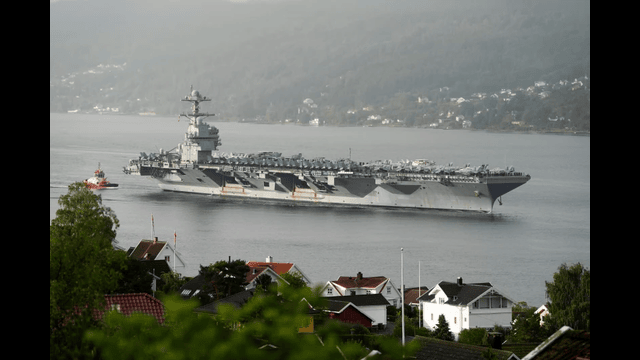
The American aircraft carrier USS Gerald R. Ford, on its way into the Oslofjord, at Drobak in Norway, Sept. 12, 2025.
The United States is escalating its military posture near Venezuela while President Donald Trump suggests potential U.S.–Venezuela discussions with President Nicolás Maduro. The comments come as America’s most advanced aircraft carrier, the USS Gerald R. Ford, arrives in the Caribbean, intensifying speculation over Washington’s strategy.
U.S. Opens Door to Potential Dialogue
President Trump said on Sunday that the U.S. “may be having some discussions” with Venezuela’s President Nicolás Maduro. He offered no details but insisted that “Venezuela would like to talk,” hinting at a possible diplomatic shift amid increasing tension.
Pressed for clarity, Trump responded, “What does it mean? You tell me, I don’t know,” before adding that he is open to speaking with anyone. Maduro’s government did not immediately comment, but the Venezuelan leadership has repeatedly accused the U.S. of trying to “fabricate” a war.
USS Gerald R. Ford Arrives Amid Counterdrug Mission
The arrival of the USS Gerald R. Ford, accompanied by multiple Navy vessels, marks the most significant U.S. military buildup in the Caribbean in decades. The deployment is part of Operation Southern Spear, which now includes nearly a dozen ships and around 12,000 sailors and Marines.
Although the U.S. describes it as a counterdrug operation, many analysts see the increased firepower as pressure on Maduro, who faces U.S. narcoterrorism charges.
Rear Adm. Paul Lanzilotta said the strike group will strengthen the U.S. ability to “protect our nation’s security and prosperity” from threats linked to narcoterrorism. Adm. Alvin Holsey described the deployment as crucial to maintaining regional stability.
Intensified Strikes at Sea Raise Questions
The carrier’s arrival coincided with the latest deadly U.S. strike on a small vessel allegedly smuggling drugs. U.S. Southern Command posted a video showing the boat exploding in the eastern Pacific, killing three men.
Since early September, 21 maritime attacks by U.S. forces in the Caribbean and Pacific have killed at least 83 people. The Pentagon has provided no public evidence confirming that those killed were affiliated with drug cartels or terrorist networks.
Trump recently hinted the U.S. could expand operations beyond naval strikes and “stop the drugs coming in by land.” When asked about future action against Venezuela, he said, “I sort of have made up my mind.”
U.S. Troops Conduct Regional Training
Alongside military activity at sea, the U.S. has increased ground exercises in Latin America. Troops are conducting joint training in Trinidad and Tobago, located only seven miles from Venezuela at its closest point.
Foreign Minister Sean Sobers said the exercises are aimed at tackling violent crime and drug trafficking routes. Marines from the 22nd Expeditionary Unit, stationed on U.S. ships near Venezuela, are leading the drills.
In Panama, U.S. troops are training at a newly reactivated jungle school. Army Secretary Dan Driscoll said the military stands ready for any orders from Trump or Defense Secretary Pete Hegseth.
Venezuela has condemned the activities as “aggression” and claims it is preparing for possible U.S. attacks through large-scale mobilizations of troops and civilians.
U.S. to Designate Venezuelan Cartel a Terrorist Group
Secretary of State Marco Rubio announced that the U.S. plans to designate Cartel de los Soles—allegedly led by Maduro and Venezuelan officials—as a foreign terrorist organization. The designation takes effect on November 24.
The move makes it a crime to provide material support to the cartel and further intensifies Washington’s legal pressure on Maduro’s government.
Rising Regional Anxiety Over U.S. Military Intent
Critics across Latin America, the United Nations, and even some U.S. lawmakers—both Democrats and Republicans—are demanding transparency about the legal basis for the boat strikes and the identity of those targeted.
Some Republicans recently blocked legislation that would restrict Trump’s authority to initiate military action against Venezuela without congressional approval.
Analysts say the deployment of the U.S. carrier sends a strong message. Elizabeth Dickinson of the International Crisis Group warned the move has heightened fears across the region.
“This is the anchor of U.S. military power returning to Latin America,” she said. “Everyone is watching with bated breath to see how far the U.S. is willing to go.”