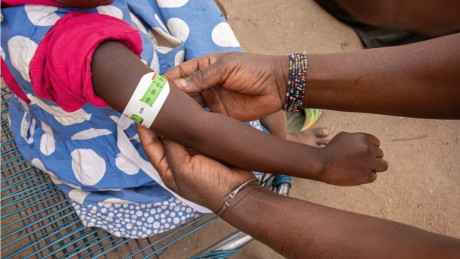
A mother measures her child’s arm using a tool to detect malnutrition, as part of ALIMA’s project in the Bandiagara region of central Mali, which received funding via the PRO initiative.
In northeast Nigeria, shelves meant to hold therapeutic food for malnourished children are nearly empty. The organization behind this effort, Action Against Hunger (ACF), has been struggling to secure critical supplies. ACF’s malnutrition relief project was once funded by the US Agency for International Development (USAID). But since funding was slashed, they’ve been unable to meet increasing demand during the hunger peak season.
This crisis isn’t isolated. Across the globe, similar life-saving aid projects have been disrupted or suspended due to a significant decline in USAID funding. These setbacks trace back to political shifts and the dismantling of several international programs under the Trump administration.
Ex-USAID Staff Take Charge
Amid this chaos, hope is emerging. A group of former USAID professionals, now jobless themselves, have banded together. Their mission: reconnect abandoned humanitarian projects with willing donors.
They call it Project Resource Optimization (PRO). The team’s goal is simple yet urgent—match funders with life-saving aid projects that are already planned, staffed, and partially resourced but stalled due to funding gaps.
“There are real lives at stake,” said Robert Rosenbaum, a former USAID portfolio manager and one of PRO’s founders. “People are dying because these projects can’t continue.”
The Urgent & Vetted Projects List
The PRO team began by curating what they now call the “Urgent & Vetted Projects” list. This spreadsheet compiles the most critical and cost-effective humanitarian programs that have lost funding.
What started as a tool to advise small family foundations has now become a matchmaking platform between donors and frontline aid efforts. Foundations and individuals have reached out with significant funds—sometimes hundreds of thousands of dollars—looking for guidance on how to make an impact.
From Foundations to Crowdfunding
PRO recently launched an online crowdfunding tool. This allows small donors to support essential programs in Sudan, Nigeria, Haiti, and more. Through one-time or recurring donations to their Rapid Response Fund, anyone can now help sustain life-saving aid projects.
“For many of these organizations, if the funding doesn’t arrive this summer, operations will shut down,” Rosenbaum said. “And restarting later will cost far more in money, time, and trust.”
ACF's Battle in Nigeria
In Nigeria, ACF is one of the programs benefitting from PRO’s initiative. They are now close to receiving new funding for their therapeutic food program, just in time for the region’s peak hunger season.
“June to September is the worst period for food insecurity,” an ACF worker explained. “Without these supplies, many children wouldn’t survive.”
While the funding will help, it only covers one part of ACF’s broader mission. They still run numerous other services—like clean water, sanitation, and healthcare—across northern Nigeria. These programs remain underfunded and in danger of collapse.
A Turnaround in Time
In Mali, the Alliance for International Medical Action (ALIMA) faced similar challenges. Their mobile health clinics and maternal care services were almost shuttered due to budget cuts.
“Half of our funding in Mali came from USAID,” said Carlota Ruiz, ALIMA’s grant manager. “We feared losing credibility and community trust.”
Thanks to PRO, a new foundation stepped in. Based on PRO’s analysis, they funded the Mali project, which will now deliver over 70,000 medical consultations and treat more than 5,000 malnourished children.
Efficiency Already in Place
One of PRO’s key strengths is its ability to leverage existing infrastructure. These stalled aid projects already have trained staff, equipment, and supply chains in place.
Rosenbaum pointed out, “The hard part—setup—is done. A little funding now can go a very long way.”
But shutting these operations down carries a heavy cost. It risks years of built trust between aid workers and communities, and may even halt progress on critical health and food access.
A Lifeline for the Forgotten
The story of PRO isn’t just about funding—it’s about people stepping up when systems fail. Former government staff are now doing what they can to sustain life-saving aid projects when traditional support has disappeared.
With the right connections and enough donor interest, these efforts are proving that international aid can still deliver, one project at a time.