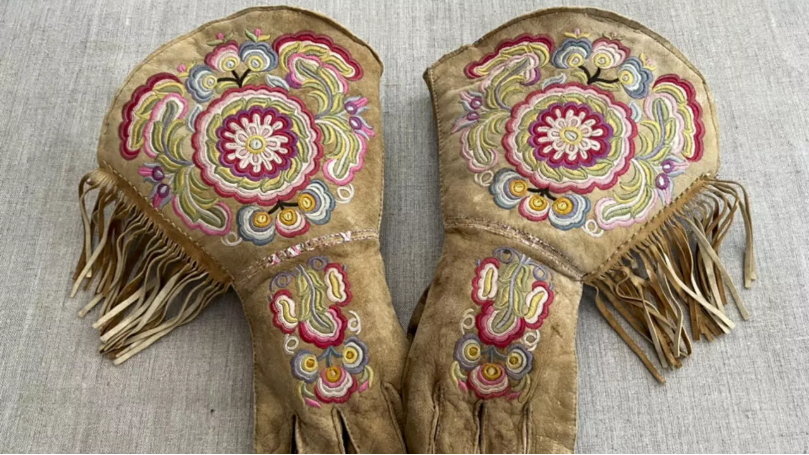
A pair of gloves crafted in the late 1800s by Cree-Métis artisan and activist Gregory Scofield reflects traditional Indigenous Canadian design. AP
Indigenous communities across Canada are preparing for the long-awaited return of sacred cultural artifacts that have been held in the Vatican for nearly 100 years. These items, many of which are considered spiritually alive and deeply connected to Indigenous ceremonies, are expected to make their way home by the end of this year.
The Vatican’s museum has housed thousands of cultural artifacts belonging to Indigenous peoples since 1925. Now, after years of conversation and growing calls for repatriation, officials anticipate an announcement within weeks confirming that dozens of these sacred pieces will be returned.
How the Return Will Work
The process will not be simple. The artifacts are expected to be transferred first from the Vatican to the Canadian Conference of Catholic Bishops (CCCB). From there, the Canadian Museum of History will likely serve as an intermediary before the items are handed back to Indigenous communities.
Cody Groat, a professor of history and Indigenous studies at Western University, said the pieces connect to an exhibition held at the Vatican in 1925. “A catalog was published listing specific artifacts,” Groat explained. “That’s our starting point for this process — the items named in that catalog. From there, we’ll see what else might be in the collection.”
Sacred, Not Display Pieces
Assembly of First Nations National Chief Cindy Woodhouse Nepinak said the items are far more than historical objects. She described them as “living, sacred pieces of our cultures and ceremonies” and urged that they “must be treated as the invaluable objects that they are.”
Groat emphasized that these artifacts should not end up behind museum glass. “When we repatriate these cultural items, we have to recognize that there’s ceremony associated with that,” he said. “This can’t just be a transfer from one box to another. These are ancestors that need to be welcomed back with ceremony and cultural protocol.”
Challenges Ahead
According to Groat, the Vatican plans to send the items to the CCCB instead of returning them directly to avoid setting a political or institutional precedent for future repatriations. The CCCB will then be responsible for returning them to Indigenous peoples in Canada.
However, Groat noted that identifying the rightful communities for each item could be difficult. “It’s hard to clearly identify which descendant community these cultural items belong to because, when they were taken, that respect wasn’t given to label them accordingly,” he explained.
The Canadian Museum of History, which has been working on its own repatriation efforts, will help with consultations once the items arrive in Canada. Groat said the museum’s involvement could make the process smoother, as long as Indigenous voices remain central throughout.
A Long-Awaited Homecoming
While the process may take time, many see it as a long-overdue act of reconciliation. The return of these sacred items marks an important moment for Indigenous communities, who have waited nearly a century to welcome their ancestors home.