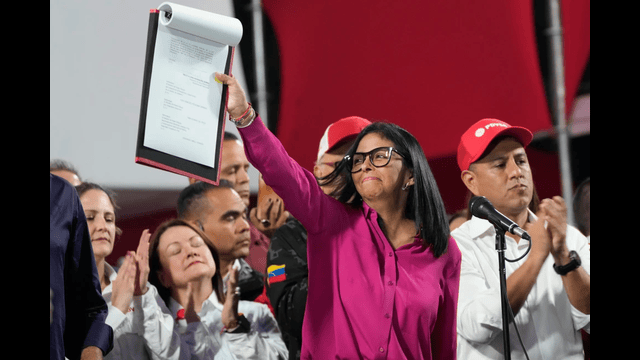
Venezuela’s acting President Delcy Rodriguez takes part in a rally holding up a copy of a new law after lawmakers approved legislation opening the nation’s oil sector to privatization, at the Miraflores Palace in Caracas, Venezuela, Thursday, Jan. 29, 2026
Venezuela has taken a dramatic turn in its oil policy. Acting President Delcy Rodríguez has signed a sweeping oil reform law. The move weakens decades of state dominance. It aims to revive a struggling industry through private and foreign investment.
The decision marks a historic break from socialist-era oil policies. Oil remains Venezuela’s economic backbone. The reform could reshape its future.
A Landmark Move in Venezuela Oil Reform
Rodríguez signed the Venezuela oil reform law shortly after parliamentary approval. The timing was striking. It came weeks after the dramatic U.S. military seizure of former president Nicolás Maduro in Caracas.
The reform is now the government’s flagship policy. It repositions oil as the engine of economic recovery. Officials say foreign capital is critical for modernization.
Rodríguez called the reform a decision for future generations. She framed it as a national reset.
Sanctions Relief Boosts Reform Momentum
The Venezuela oil reform coincided with U.S. policy shifts. Washington began easing long-standing oil sanctions. Restrictions were first imposed under the Trump administration’s earlier term.
The U.S. Treasury also expanded permissions for American energy companies. This change allows deeper operations inside Venezuela.
Rodríguez also held talks with U.S. President Donald Trump. She spoke with Secretary of State Marco Rubio. Discussions focused on oil sales and revenue oversight.
These parallel actions signal a thaw in bilateral relations.
Private Companies Take the Lead
The new Venezuela oil reform ends PDVSA’s monopoly. Private firms can now manage oil production and sales. Pricing will no longer remain under exclusive state control.
Companies must prove financial and technical strength. Each project requires an approved business plan from the Oil Ministry.
Firms will operate at their own risk. The state steps back from daily control.
Arbitration and Investor Protections
A key change targets investor confidence. The law allows independent arbitration. Disputes no longer must stay within Venezuelan courts.
Foreign investors see this as essential protection. Courts have long been viewed as politically influenced.
The reform also updates oil royalties. A 30 percent cap is introduced. Rates can vary by project needs and investment scale.
U.S. Oil Giants Watch Closely
Officials expect the Venezuela oil reform to reassure U.S. energy companies. Many lost assets during past nationalizations.
Those losses followed reforms enacted two decades ago. PDVSA was then made the dominant partner in all major projects.
Some firms have remained cautious since. The new law seeks to rebuild trust.
Economic Hopes and Political Debate
Government lawmakers say the reform can transform the economy. Orlando Camacho called it a turning point.
Opposition leaders remain cautious. Lawmaker Antonio Ecarri demanded transparency safeguards. He proposed public disclosures of oil revenues and funding.
Ecarri argued oversight failures fueled corruption. He said accountability is also a legal guarantee.
Workers Celebrate Policy Shift
Oil workers gathered in Caracas to celebrate the vote. Many wore red jumpsuits and hard hats. Venezuelan flags filled the legislative palace.
Supporters later marched with ruling-party lawmakers. The event signaled grassroots backing within the oil sector.
Breaking with Chávez-Era Doctrine
The Venezuela oil reform reverses policies set under Hugo Chávez. Chávez expanded state control after taking office in 1998.
Oil revenues funded major social programs. High prices brought nearly $1 trillion between 1999 and 2011.
Chávez forced PDVSA into majority ownership roles. Foreign contracts were torn up. ExxonMobil and ConocoPhillips lost assets.
Arbitration claims from that era remain unpaid.
Decline, Crisis, and a New Path
PDVSA later declined due to mismanagement and corruption. Oil prices fell. Production collapsed.
By 2013, Venezuela entered a deep economic crisis. Over 7.7 million citizens eventually migrated.
U.S. sanctions worsened the downturn.
Now, the Venezuela oil reform opens a new chapter. Whether it delivers revival depends on trust, stability, and execution.