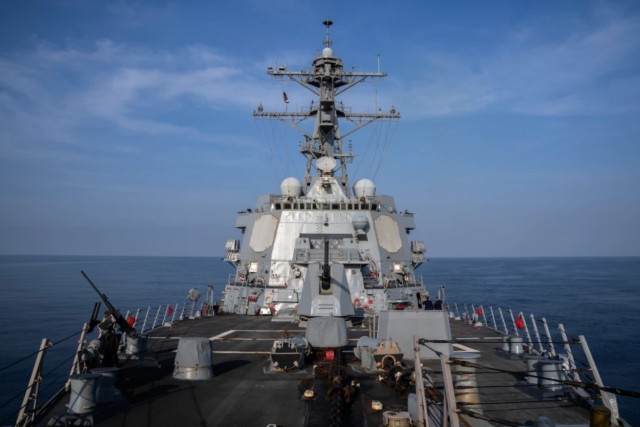
View of the U.S.S. Gravely (DDG 107) destroyer, Feb. 13, 2024.
The United States is sending three guided-missile destroyers toward Venezuelan waters. The move signals President Donald Trump’s renewed push to pressure Latin American drug cartels and strengthen counter-narcotics operations in the region.
US Navy Deployment to the Caribbean
According to officials, the USS Gravely, USS Jason Dunham, and USS Sampson will soon arrive near Venezuela. The Pentagon confirmed the deployment, noting the destroyers will operate in the region for several months.
These destroyers are equipped with advanced Aegis systems, designed for both defense and offensive operations. Their presence highlights Washington’s focus on combating drug trafficking networks operating across Latin America.
Trump’s War on Cartels
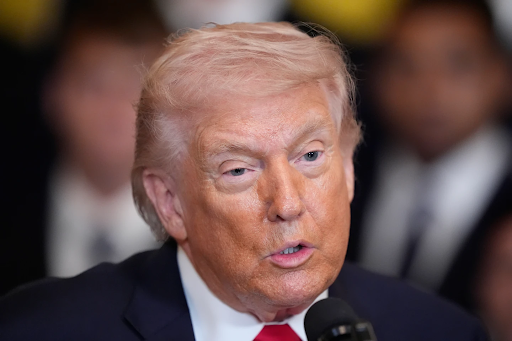
Trump has repeatedly blamed cartels for flooding American streets with fentanyl and cocaine. He argues these networks fuel violence across U.S. cities.
The administration has also accused the Venezuelan government of working with international cartels. Earlier this month, the U.S. doubled its reward for the arrest of President Nicolás Maduro, raising it to $50 million. Officials allege Maduro is a key player in global narco-trafficking operations.
Pressure on Mexico and Regional Cooperation
Beyond Venezuela, Trump has pushed Mexico’s President Claudia Sheinbaum for deeper security cooperation. He has urged tougher action against cartels, a demand he says her predecessor ignored.
But Sheinbaum has firmly rejected the idea of U.S. military intervention. She insists Mexico’s sovereignty will not be compromised, even under pressure from Washington.
Terrorist Designation for Cartels
In February, Trump designated Venezuela’s Tren de Aragua, MS-13 in El Salvador, and six Mexico-based groups as foreign terrorist organizations.
Traditionally, such labels are applied to groups like al-Qaida or ISIS. The Trump administration, however, argues cartels deserve the same treatment due to their international reach, smuggling operations, and violent expansion tactics.
Venezuela Responds with Defiance
Venezuela’s government has dismissed Washington’s accusations. Foreign Minister Yvan Gil called U.S. claims “baseless” and said they reveal the “failure of its policies in the region.”
He added, “True effectiveness against crime comes from respecting sovereignty, not threatening nations.”
In addition, Venezuela announced a temporary ban on drones in its airspace. The move follows growing tensions, as Maduro recalled the 2018 incident when explosive-laden drones detonated near him during a live speech.
Maduro Mobilizes Militias
Amid U.S. pressure, Maduro announced the mobilization of 4.5 million militia members. These civilian militias, created by Hugo Chávez, are intended to support the armed forces against internal and external threats.
“The empire has gone mad,” Maduro said, accusing Washington of destabilizing Venezuela. He did not directly reference the U.S. destroyer deployment but warned of increased threats against his nation’s peace.
Ongoing Legal Battles Against Maduro
Maduro’s troubles with U.S. authorities are not new. In 2020, during Trump’s first presidency, Maduro and several allies were indicted in New York on charges of narco-terrorism and conspiracy to traffic cocaine.
At that time, the U.S. offered a $15 million reward for his capture. With the reward now at $50 million, the pressure on Maduro has intensified.
A Region on Edge
The deployment of U.S. destroyers underscores escalating tensions between Washington and Caracas. Trump’s administration sees Venezuela as a hub for cartels undermining U.S. security.
Venezuela, meanwhile, portrays the moves as imperial aggression, insisting it will defend its sovereignty at all costs.
The coming months may reveal whether the U.S. naval presence deters cartel activity — or sparks a new wave of confrontation in Latin America.