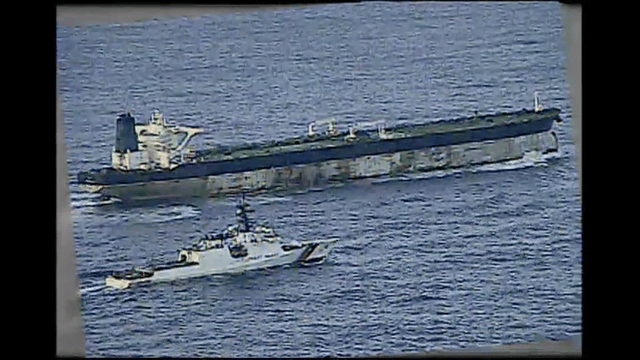
This image from video provided by the U.S. Department of Defense, shows the U.S. Coast Guard cutter Munro shadowing the MV Bella 1 in the North Atlantic Ocean during the maritime interdiction operation Wednesday, Jan. 7, 2026
The United States is moving aggressively to control Venezuelan oil flows worldwide.
The strategy combines tanker seizures, selective sanction relief, and direct oversight of oil sales.
President Donald Trump’s administration says the goal is economic pressure without military conflict.
At the center of the move is Venezuelan oil, the country’s most powerful leverage point.
A New Phase in Venezuelan Oil Control
The Trump administration wants full authority over Venezuelan oil distribution.
Officials say only U.S.-approved channels will move oil in or out of Venezuela.
The Energy Department confirmed that all Venezuelan oil trade must align with U.S. law.
National security interests will guide every shipment and sale.
This approach follows the removal of President Nicolás Maduro in a sudden nighttime operation.
Washington believes Venezuelan oil can shape the country’s political and economic future.
Control over the world’s largest proven crude reserves also gives leverage over global oil prices.
White House Signals Economic Pressure Strategy
Vice President JD Vance described Venezuelan oil as a pressure tool.
He said the U.S. can control Venezuela’s “purse strings” by regulating oil buyers.
Oil sales, he explained, would only continue if American interests are served.
Vance stressed that this strategy avoids American military casualties.
Economic pressure, he said, can be just as effective as armed force.
The administration believes Venezuelan oil control offers maximum influence at minimal cost.
Seized Tankers Expand US Enforcement
U.S. forces seized two additional tankers linked to Venezuelan oil shipments.
The Bella 1 was captured in the North Atlantic for sanction violations.
The M Sophia was taken in the Caribbean under similar grounds.
Both vessels had recently docked in Venezuela or were heading there.
They join two tankers seized earlier, the Skipper and the Centuries.
Officials say the actions enforce the existing Venezuelan oil embargo.
High-Seas Chase Raises Tensions
The Bella 1 attempted to evade U.S. forces after leaving Venezuela.
When the Coast Guard tried to board, the vessel fled.
Authorities tracked it under a federal court warrant.
During the chase, the ship was renamed Marinera and reflagged to Russia.
Crew members reportedly painted a Russian flag on the hull.
Russia protested, citing nationals aboard and demanding humane treatment.
A senior Russian lawmaker called the seizure “blatant piracy.”
The U.S. Justice Department said crew members may face criminal charges.
Officials warned more tanker seizures could follow.
Venezuelan Oil Sales Under US Oversight
Alongside enforcement, Washington is easing some sanctions on Venezuelan oil.
The Energy Department outlined a plan to oversee global oil sales.
Initial volumes range between 30 million and 50 million barrels.
Sales will continue indefinitely, officials said.
Proceeds will be held in U.S.-controlled bank accounts.
Funds will be distributed at the discretion of the Trump administration.
Secretary of State Marco Rubio said seized oil could be part of the deal.
He said Venezuela needs cooperation to avoid economic collapse.
Without U.S. approval, oil revenues would dry up.
Caracas Responds With Cautious Acceptance
Venezuela’s state oil firm PDVSA confirmed talks with Washington.
It described the process as legal and commercially structured.
Officials compared it to existing arrangements with Chevron.
Acting President Delcy Rodríguez downplayed the development.
She called U.S.-Venezuela oil dealings routine, not extraordinary.
Rodríguez stressed Venezuela’s need for diversified global relations.
Shadow Fleet and Smuggling Networks
U.S. officials say the seized ships belonged to a shadow fleet.
These tankers allegedly smuggle oil for sanctioned nations.
Countries include Venezuela, Russia, and Iran.
The M Sophia had disabled its tracking system for months.
Such tactics are common in Venezuelan oil smuggling operations.
Satellite data confirmed it loaded oil at Venezuela’s Jose Terminal.
Maritime analysts estimate the ship carried 1.8 million barrels.
At current prices, the cargo is worth about $108 million.
The seizure underscores Washington’s expanding reach over Venezuelan oil.