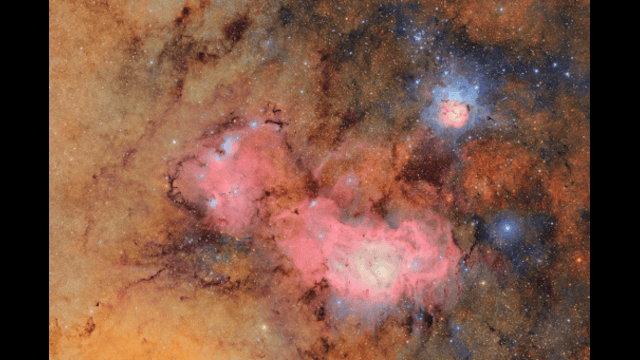
This image provided by the NSF-DOE Vera C. Rubin Observatory shows 678 separate images taken by the observatory in just over seven hours of observing time. Combining many images in this way clearly reveals otherwise faint or invisible details, such as the clouds of gas and dust that comprise the Trifid nebula (top right) and the Lagoon nebula, which are several thousand light-years away from Earth.
The universe just got a little clearer—and more colorful. For the first time ever, the world’s largest digital camera has captured stunning, high-resolution images of the cosmos. This historic milestone marks a major leap forward in space observation, opening new doors to uncover celestial secrets.
The powerful camera is part of the Vera C. Rubin Observatory, stationed on a remote mountaintop in Chile. Funded by the U.S. National Science Foundation and the Department of Energy, the observatory is poised to become a key player in the future of space exploration.
First Images: Nebulas, Galaxies, and Cosmic Wonders
The first photos taken by this massive digital camera are nothing short of breathtaking. Featured prominently are the Trifid and Lagoon nebulas, vibrant and rich with color, located thousands of light-years from Earth. The images also showcase the Virgo Cluster, home to dozens of galaxies, including two spectacular blue spiral galaxies.
Each photo is a window into the distant universe, revealing features that were previously too faint or far away to be observed in such detail.
Surveying the Southern Sky for a Decade
The Vera C. Rubin Observatory will not stop with just a few impressive pictures. Over the next 10 years, it will survey the entire southern sky, systematically capturing images of deep space.
Its mission? To map 20 billion galaxies, detect asteroids, and unveil hidden corners of the cosmos. With the help of this massive digital camera, researchers aim to create the most detailed record of our universe to date.

This image provided by the NSF-DOE Vera C. Rubin Observatory shows another small section of the observatory’s total view of the Virgo cluster.
Honoring a Legacy: Vera Rubin and the Dark Matter Mystery
This astronomical project is named in honor of Vera C. Rubin, a trailblazing astronomer whose work reshaped our understanding of the universe. Rubin’s groundbreaking research gave us the first hints of dark matter, an invisible force that makes up most of the universe’s mass but remains undetected.
Now, her legacy lives on through this observatory, which hopes to shine light on dark matter and its counterpart, dark energy. These two mysterious forces are believed to govern much of the universe’s structure and expansion.
A Technological Marvel: Largest Digital Camera Ever Built
The heart of the observatory’s power lies in its record-breaking digital camera. As the largest ever built, it offers unparalleled detail and range. The camera’s sensors can detect even the faintest sources of light across massive cosmic distances.
Its capabilities will help astronomers spot new celestial objects, from faraway galaxies to nearby asteroids. Scientists are hopeful that the observatory will revolutionize how we study space and its endless mysteries.
A New Era for Space Exploration
With these first images, the Vera C. Rubin Observatory marks the beginning of a new chapter in astronomy. What lies ahead could reshape what we know about time, matter, and the very fabric of space itself.
As its massive digital camera continues to scan the skies, the world watches with anticipation. Every new image brings us one step closer to unlocking the ultimate secrets of the universe.