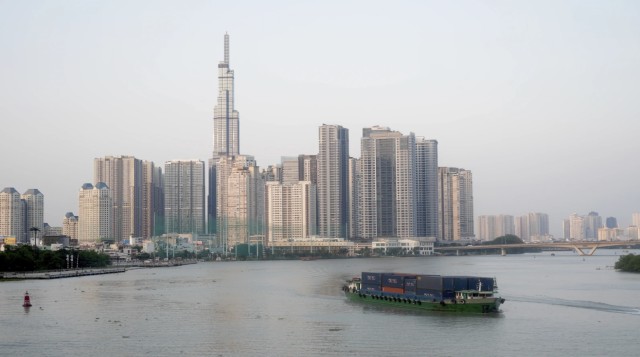
A cargo ship sails on Saigon river in Ho Chi Minh city, Vietnam on April 28, 2025
Beneath red banners in Hanoi’s central party school, Communist Party chief To Lam declared a “new era of development.”
It marked the start of Vietnam’s most ambitious economic transformation in decades.
The goal is clear — become a high-income nation by 2045 and join the ranks of Asia’s “tiger economies.”
Vietnam’s journey won’t be easy.
It must balance rapid growth with deep reforms, tackle climate threats, and address an aging population.
The challenge is made tougher by global trade tensions, especially with the United States.
From Poverty to a Manufacturing Powerhouse
In 1990, the average Vietnamese could afford $1,200 worth of goods and services per year.
Today, that figure is over $16,000, adjusted for local prices.
Shiny highways, high-rise skylines, and a growing middle class have lifted millions from poverty.
But Vietnam’s low-cost, export-led growth model is slowing.
Economists warn of the “middle-income trap” — when economies stagnate without major reforms.
To avoid this, Vietnam is focusing on private sector growth, high-tech industries, and sustainable energy.
Trade Tensions with the U.S.
Vietnam’s export boom has made the U.S. its largest market.
In 2024, it recorded a $123.5 billion trade surplus with America.
This angered former President Donald Trump, who threatened tariffs of up to 46%.
The two countries reached a compromise — a 20% levy on most goods, and double for suspected transshipped items.
Vietnam accepted the deal, as long as its tariffs remain competitive with regional rivals.
Betting on High-Tech, Green Energy, and Infrastructure
Like South Korea and Taiwan before it, Vietnam is choosing strategic sectors to drive growth.
But unlike them, it cannot rely on a single winning industry.
It is making “multiple big bets.”
Hanoi, Ho Chi Minh City, and Danang are emerging as hubs for semiconductors, AI, and renewable energy.
Massive infrastructure projects are underway, including a $67 billion high-speed railway linking north and south in eight hours.
The government also plans to turn Ho Chi Minh City and Danang into global financial centers.
Foreign investors will get tax breaks, fintech support, and faster dispute resolution.
Private Businesses to Lead the Charge
A major policy shift came in May with Resolution 68.
It declared private businesses the “most important force” in Vietnam’s economy.
This is a break from decades of state and foreign company dominance.
Local firms will now have better access to loans, priority in government contracts, and incentives for innovation.
Even mega-projects, once reserved for state enterprises, are open to private bidding.
By 2030, Vietnam aims to have 20 globally competitive private firms.
Urgency from Climate Change
Climate change is an immediate threat to Vietnam’s growth.
Typhoon Yagi caused $1.6 billion in damage last year, cutting GDP by 0.15%.
Industrial parks like DEEP C are investing in flood resilience to protect factories.
The World Bank warns that without urgent action, Vietnam could lose up to 14.5% of GDP annually by 2050.
One million people could fall into extreme poverty by 2030.
Racing Against Demographic Time
Vietnam is also facing a shrinking workforce.
Its “golden population” window will close by 2039.
The labor force will peak just three years later.
To prepare, the government is expanding preventive healthcare and gradually raising the retirement age.
Encouraging more women to join the workforce is also a priority.
A Narrow Window for Reform
Vietnam’s leaders know the clock is ticking.
The country must reform its economy, adapt to climate change, and prepare for an older population — all at once.
If successful, it could join the ranks of Asia’s economic powerhouses.
If not, the dream of becoming the next “Asian tiger” may slip away.