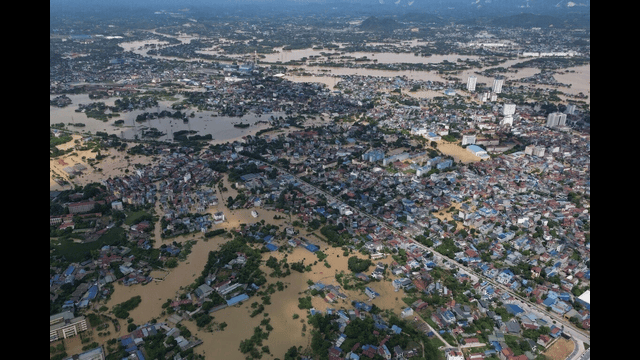
This aerial image shows flooding in the aftermath of Typhoon Matmo in Thai Nguyen.
Vietnam is rethinking its entire flood management strategy after a year of destructive storms left cities underwater and hillsides collapsing. The country is facing a new climate reality — one where storms are stronger, rain is heavier, and recovery time is shrinking.
To adapt, Vietnam is investing billions into reengineering its cities, rivers, and drainage systems to live with water — not fight it.
A $6 Billion Plan to Tackle Climate Extremes
Under its national master plan through 2030, the government has pledged more than $6 billion to improve resilience. This includes early-warning systems, relocating vulnerable communities, and redesigning cities to handle deluges more naturally.
The approach focuses on “sponge cities” — urban environments that absorb, store, and release water like natural ecosystems. In smaller cities like Vinh, flood basins are being dug, riverbanks turned into green zones, and drainage systems expanded.
These efforts are no longer optional. Storms such as Ragasa, Bualoi, and Matmo have repeatedly battered Vietnam this year, flooding neighborhoods before the land could recover from the previous disaster.
Climate Change is Redrawing Vietnam’s Map
Experts warn that the frequency and intensity of Vietnam’s storms are a direct outcome of climate change. Warmer oceans — nearly 1°C hotter than before the industrial age — feed storms with more moisture, creating prolonged and devastating rainfall.
“Vietnam and its neighbors are on the front lines of climate disruption,” said Professor Benjamin Horton of the City University of Hong Kong. The pattern of back-to-back storms in 2025, he said, is a “clear signal” of global warming.
As Typhoon Kalmaegi strengthens off the coast, scientists caution that more storms are likely. The combination of warmer seas and urban vulnerability makes Vietnam a prime target for extreme weather.
Economic Toll: Floods Cost Vietnam $1.4 Billion in 2025
The financial cost has been staggering. Floods and landslides have disrupted farming, fisheries, and factories — the pillars of Vietnam’s export-driven economy.
State media estimates $1.4 billion in losses this year alone.
Looking ahead, Vietnam projects it will need between $55 billion and $92 billion this decade to adapt to climate impacts. For a developing country aiming to become a high-income economy by 2045, that’s a heavy burden.
Cities Overrun by Water
Urbanization has made Vietnam’s major cities — Hanoi and Ho Chi Minh City — increasingly flood-prone. Built on river deltas once rich in wetlands, both have lost their natural ability to absorb rainwater.
In Hanoi, flooding in October submerged streets for nearly a week. The outdated colonial-era drainage network collapsed under the pressure of nonstop rain. Residents waded through brown water while motorbikes stalled mid-road.
For vegetable seller Dang Thuan, the floods are personal. Her home floods knee-deep each season. “We can’t afford to move,” she said. “So every time it rains hard, we just wait and hope.”
A Kyoto University study found Hanoi lost nearly two-thirds of its water bodies between 1986 and 1996 during the construction boom. By 2020, the city had lost water bodies equal to 285 football fields.
Now, three-quarters of Hanoi is at risk of flooding, according to a 2024 study by environmental engineer Hong Ngoc Nguyen. She argues that “we can’t control the water” and calls for greener solutions inspired by Singapore’s riverbank designs, which slow stormwater rather than rush it away.
‘Living With Water’: A Global Shift
Vietnam’s struggle mirrors a global urban challenge. Cities from Bengaluru in India to Johannesburg in South Africa are learning to coexist with water rather than drain it.
Urban experts in Vietnam are pushing for a cultural shift. Former planning chief Ngo Trung Hai said the country must “learn to live with heavy rainfall” instead of trying to eliminate it. European business groups have also urged Ho Chi Minh City to adopt the “sponge city” model.
Some developers are listening. In Nha Trang, the Sun Group is constructing a township that uses 60 hectares of wetlands to store rainwater, reduce flooding, and lower urban temperatures.
Climate adaptation specialist Anna Beswick from the London School of Economics summed it up:
“If we plan based on past experience, we won’t be resilient in the future.”
A Future Built to Breathe
Vietnam’s new flood strategy is more than just infrastructure — it’s a mindset shift. By embracing nature-based urban design, the country hopes to turn crisis into opportunity.
The goal is clear: build cities that absorb the storm, sustain their people, and survive the century ahead.