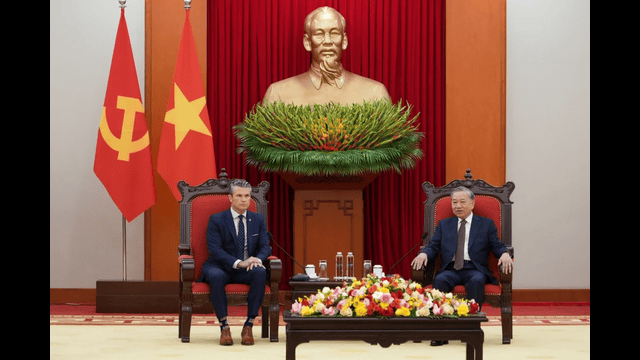
US Defense Secretary Pete Hegseth, left, and General Secretary of the Communist Party of Vietnam To Lam talk during a meeting in Hanoi, Vietnam, November 2, 2025.
Vietnam has publicly strengthened its relations with the US in recent years.
Yet, an internal military document reveals deep mistrust toward Washington.
The report suggests Vietnam’s army is quietly preparing for a possible American conflict.
It also reflects long-standing fears inside the Communist leadership.
Released Tuesday by The 88 Project, the document offers rare insight.
It shows how Vietnam balances diplomacy with strategic suspicion.
The contrast highlights the complexity shaping modern Vietnam-US relations.
Military Sees the US as a Potential Aggressor
The document was drafted by Vietnam’s Ministry of Defense in August 2024.
It is titled “The 2nd U.S. Invasion Plan.”
The text describes the United States as a “belligerent” power.
Military planners warn of unconventional warfare and foreign intervention.
They argue the US could create pretexts for military action.
While immediate war risks are low, vigilance is advised.
Fear of a Color Revolution Drives Strategy
The document reflects deep concern about internal destabilization.
Vietnamese leaders fear a Western-backed “color revolution.”
Examples include Ukraine’s Orange Revolution and the Philippines’ Yellow Revolution.
Officials worry foreign influence could spark mass protests.
They fear such unrest could threaten Communist Party control.
These anxieties shape Vietnam’s security and foreign policy thinking.
A Broader Pattern Across Government
According to The 88 Project, these views are not isolated.
Similar concerns appear in other internal government documents.
This suggests consensus across ministries and institutions.
Ben Swanton, the report’s author, stressed this point clearly.
He said the fears are widespread, not fringe thinking.
The mindset reflects historical memory and political caution.
Vietnam US Relations Improved on the Surface
In 2023, Vietnam and the US upgraded ties significantly.
President Joe Biden signed a Comprehensive Strategic Partnership with Hanoi.
The agreement placed the US alongside China and Russia as top partners.
Publicly, both sides praised mutual respect and cooperation.
Trade, technology, and security ties expanded rapidly.
On paper, Vietnam US relations reached a historic high.
Internal Doubts Persist Despite Partnership
Despite the upgrade, military planners remain skeptical.
The document says the US wants to reshape Vietnam’s political system.
It accuses Washington of promoting democracy and human rights to weaken socialism.
Swanton described the document as revealing.
He said Vietnam does not see the US as a true ally.
Instead, leaders view Washington as an existential risk.
Government Silence and US Response
Vietnam’s Foreign Ministry declined to comment on the report.
No official response addressed the document directly.
The silence reinforces the sensitivity of the issue.
The US State Department avoided discussing the document.
However, it defended the partnership’s goals.
Officials emphasized stability, independence, and prosperity for Vietnam.
Tensions Inside Vietnam’s Leadership
Analysts say the document highlights internal divisions.
Conservative military factions remain wary of US intentions.
They prefer caution over rapid alignment with Washington.
Researcher Nguyen Khac Giang noted lingering discomfort.
The military has never fully embraced closer US ties.
Historical distrust still shapes strategic decisions.
War Memories and Development Aid Disruptions
Vietnam’s military retains vivid memories of the past war.
That conflict ended only in 1975.
These memories continue to influence perceptions.
Trust also suffered under recent US policy shifts.
Cuts to USAID disrupted cleanup of Agent Orange contamination.
Such actions reinforced doubts about long-term US commitment.
Balancing China and the United States
Vietnam faces pressure from both major powers.
China is a regional rival, especially in the South China Sea.
Yet, documents portray China as less threatening than the US.
China is Vietnam’s largest trading partner.
The US remains its biggest export market.
This economic reality forces careful diplomatic balancing.
An Uneasy Future for Vietnam US Relations
Vietnam’s leadership continues to hedge its bets.
Stronger ties bring benefits but also risks.
Fear of political interference remains strong.
The document shows one clear truth.
Vietnam US relations are improving, but mistrust endures.
Behind diplomacy lies a strategy shaped by caution and survival.