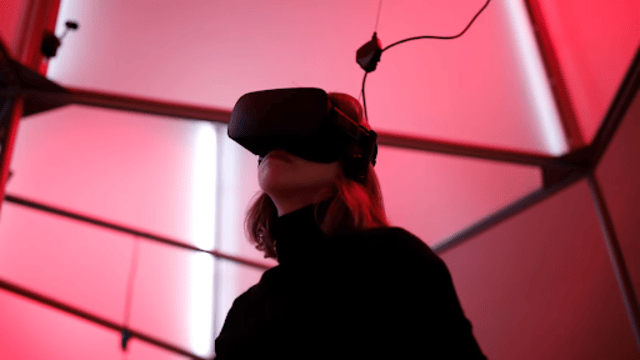
A woman plays a video game with the Oculus Rift VR headset at a video arcade dedicated to virtual reality in Paris, France on December 5, 2016.
Virtual reality (VR) was once hailed as the next frontier of entertainment. When Oculus Rift hit the scene over a decade ago, expectations soared. Yet, in 2025, many would argue VR has yet to truly take off. However, signs are mounting that the long-awaited VR entertainment revolution might finally be within reach.
Tech Titans Renew Their Bet on VR Entertainment
In recent months, major players like Meta and Apple have doubled down on immersive experiences. Meta is reportedly collaborating with Disney, A24, and other top studios to develop VR-ready content for its Quest headsets. Meanwhile, Apple is pushing updates to its Vision Pro headset that make content sharing easier, including watching 3D movies with friends in virtual spaces.
Earlier this year, Apple launched an immersive Metallica concert experience for Vision Pro users. These moves suggest that tech giants believe audiences are ready to move beyond traditional screens and step into new digital realms.
The Chicken-and-Egg Conundrum of VR Content
One major reason VR hasn’t become mainstream is the classic chicken-and-egg dilemma. Without widespread adoption, developers are hesitant to invest in premium VR content. But without quality content, users won’t adopt the technology.
Despite this cycle, there's growing optimism. Sarah Malkin of Meta’s Reality Labs believes we’re already experiencing the shift. “The ‘it moment’ is when these experiences become part of daily life,” she said.
Recent data from IDC supports her claim. In 2024, global shipments of AR and VR headsets grew by 10%, reaching 7.5 million units. U.S. sales jumped nearly 31%. Although a dip is expected in 2025 due to launch delays, a 98.5% rebound is predicted in 2026.
A Costly Road to the Future
The road has been expensive. Meta alone has poured $46 billion into its Metaverse vision over three years. Reality Labs posted a $4.2 billion operating loss in Q1 2025, with revenues under $500 million.
Still, the company presses on. Meta invested $3.5 billion in eyewear maker EssilorLuxottica, while Snap and Google are also gearing up with new AR and VR devices. Samsung, in partnership with Google, is preparing to unveil its Project Moohan headset powered by Android XR.
Exclusive VR Content: The Key to Unlocking Demand
What can drive consumers to adopt VR headsets en masse? Experts say the answer is exclusive, native content. Industry consultant Jenna Seiden argues that simply porting existing shows to VR won’t cut it. “You need to build for the medium,” she emphasized.
She points to how platforms like HBO Max and Apple TV+ grew using exclusive shows. VR platforms could do the same — not just with series, but with sports and concerts.
Felix & Paul Studios co-founder Paul Raphaël believes immersive live sports could be a game changer. Using 180-degree cameras, sports events become prime VR content. “It’s a direct path to engaging audiences,” he noted.
Hollywood Eyes VR as a Lifeline
With streaming fatigue, cable collapse, and declining box office numbers, Hollywood is hungry for a fresh distribution channel. Jack Davis of CryptTV believes headsets could be that new pipeline. “It’s one of the few platforms where premium content still makes sense,” he said.
Funding Hurdles Slow XR’s Progress
Despite excitement, funding in extended reality (XR) has dipped. Crunchbase reports XR investments peaked at $4 billion in 2021 but dropped to $347 million in 2025. In contrast, AI and self-driving tech have seen explosive growth, with AI VC funding hitting $130 billion this year.
Still, Bertrand Nepveu of Triptyq Capital sees a turnaround. “Budgets are flowing back into XR now that AI’s role is better understood,” he said.
Convincing the Masses Remains the Real Challenge
While hardware improves and content expands, a major hurdle remains: user buy-in. These headsets need to be worth the cost and comfortable to wear. Apple has tried to reframe the Vision Pro as a spatial computing device — good for both work and play.
And while predictions differ — from “any day now” to “ten years away” — one thing is clear: VR entertainment is evolving. Raphaël summed it up best: “Flat screens won’t vanish, but they’ll feel as outdated as black-and-white films.”
After years of missed opportunities, the VR entertainment revolution may finally be on the horizon. With the right mix of exclusive content, sleek hardware, and strategic investment, virtual reality could soon redefine how we experience storytelling.