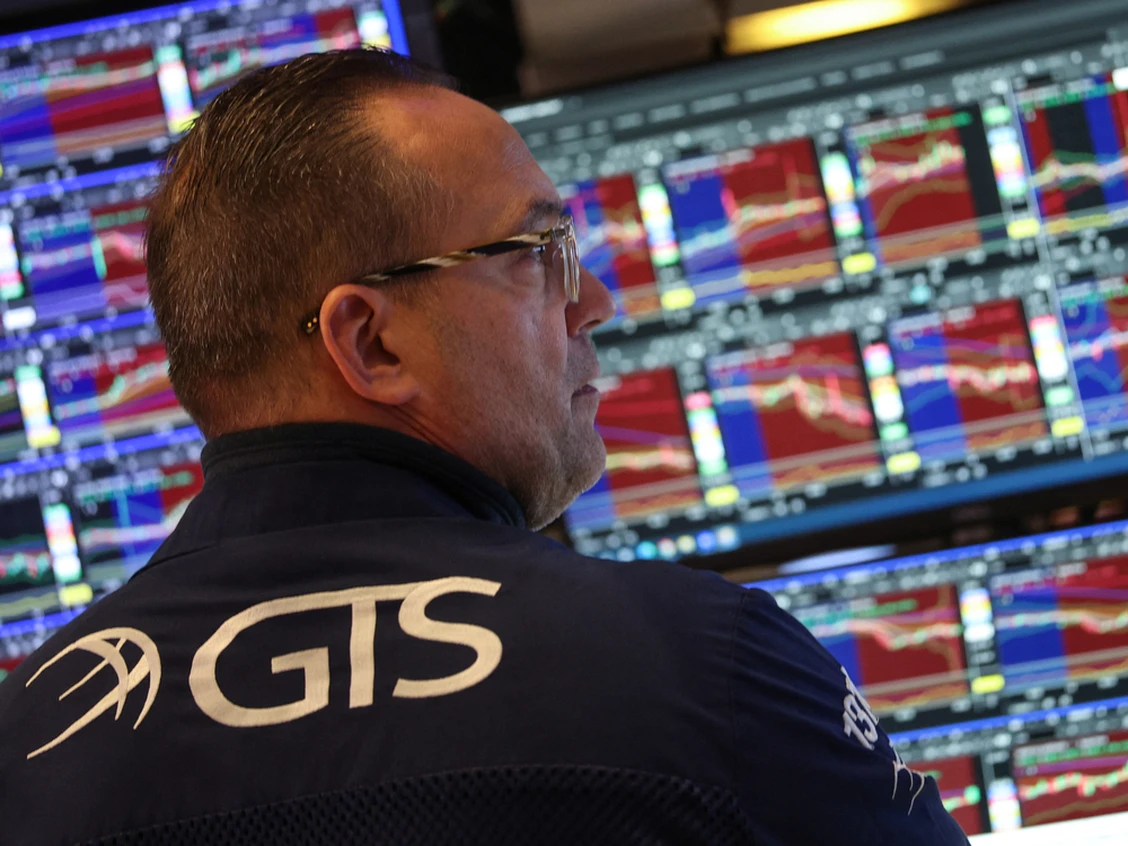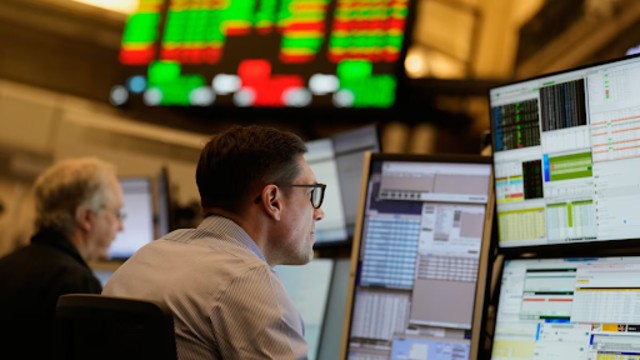
Ed Curran is seen at work on Wednesday inside the New York Stock Exchange in New York. (Photo by Seth Wenig, AP)
Wall Street had a slow start this week, with major stock indexes barely moving on Monday. This quiet tone comes just as markets brace for a week packed with big announcements and earnings reports that could rattle investors. The calm followed news of a trade agreement between the United States and the European Union, where the U.S. agreed to apply a 15% tax on cars and other goods—less than the harsher tariffs earlier threatened by former President Donald Trump.
While the S&P 500 nudged up slightly—less than 0.1%—enough to set a record high for the sixth straight day, the Dow Jones Industrial Average slipped by 64 points. Meanwhile, the tech-heavy Nasdaq rose 0.3% to a new high.
Tesla was a standout performer, climbing 3% after CEO Elon Musk revealed a multibillion-dollar deal with Samsung Electronics for chip supply. Samsung’s shares in South Korea jumped nearly 7% after the announcement. Other tech companies in the semiconductor and AI sectors followed suit, riding a wave of enthusiasm that began last week when Alphabet announced it would invest $85 billion this year, mostly in AI infrastructure.
Advanced Micro Devices gained 4.3%, and Super Micro Computer shot up more than 10%. But not all companies fared well—Revvity, a life sciences firm, fell 8.3% despite reporting better-than-expected earnings. The drop came after it issued a profit forecast that disappointed analysts.
Investors are closely watching corporate profits this quarter. Stocks have climbed rapidly in recent months, mainly due to optimism that Trump might ease some of his proposed tariffs. But many experts say that unless earnings follow suit, stock prices might be too high to justify.
For the day, the S&P 500 added just over a point to reach 6,389.77. The Dow ended at 44,837.56, and the Nasdaq closed at 21,178.58.
Looking ahead, this week could bring major market moves. Chris Larkin of E-Trade called it “about as busy as a week can get.” Nearly a third of S&P 500 companies, including giants like Apple, Amazon, Meta, and Microsoft, will report their earnings. These companies are so influential that their share price changes could shift the entire market. Microsoft alone is valued at $3.8 trillion.
Wednesday brings another big event—the U.S. Federal Reserve’s decision on interest rates. Trump has urged the Fed to lower rates, which could spur economic growth. But Fed Chair Jerome Powell is waiting for more data before making a move, especially on how tariffs are influencing inflation. The central bank last cut rates in late 2024 and has held steady since.
Market watchers expect the next cut to come in September, though a few of Trump’s Fed appointees may push for earlier action.
Several key economic reports are also expected this week. Tuesday will reveal consumer confidence levels and the number of open jobs. Wednesday brings the first look at U.S. economic growth during the spring, which analysts expect to show a slowdown. Thursday will see the release of the Fed’s preferred inflation measure. A lower-than-expected figure could make rate cuts more likely, while a hotter number could cause hesitation.
Finally, Friday will wrap up the week with the U.S. jobs report, showing how many people were hired or laid off in June.
Bond markets remained steady ahead of these announcements. The yield on the 10-year Treasury rose slightly to 4.41%, while the 2-year yield edged up to 3.92%.
Outside the U.S., European markets dipped slightly following the trade deal. Meanwhile, Chinese stocks rose ahead of trade talks with a U.S. delegation in Sweden. Hong Kong’s Hang Seng Index gained 0.7%, and Shanghai inched up 0.1%. However, Japan’s Nikkei 225 dropped 1.1%, one of the steepest declines across Asian markets.