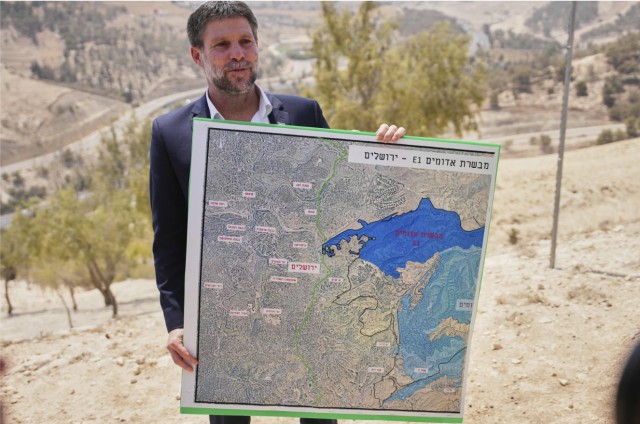
CORRECTS DAY Israeli Finance Minister Bezalel Smotrich holds a map that shows the E1 settlement project during a press conference near the settlement of Maale Adumim, in the Israeli-occupied West Bank, Thursday, Aug. 14, 2025.
Israel has approved a major settlement project in the occupied West Bank. The decision, announced Wednesday, is seen as a move that could divide the territory and cripple hopes for a future Palestinian state.
The project, planned in the E1 area east of Jerusalem, has long been a flashpoint in the Israeli-Palestinian conflict.
Settlement Approval Sparks Global Concerns
The E1 development has been under discussion for more than two decades. Previous U.S. administrations pressured Israel to freeze it. Now, final approval signals a significant policy shift.
The international community widely considers settlement expansion in the West Bank illegal under international law. Rights groups argue it undermines peace efforts and blocks the two-state solution.
Israeli Leaders Defend Expansion
Far-right Finance Minister Bezalel Smotrich celebrated the approval. He described it as a direct response to Western nations recognizing Palestinian statehood.
“The Palestinian state is being erased not with slogans but with actions,” Smotrich said. “Every settlement, every neighborhood, every housing unit is another nail in the coffin of this dangerous idea.”
Prime Minister Benjamin Netanyahu has repeatedly rejected the idea of a Palestinian state. He insists Israel will maintain control over the West Bank, East Jerusalem, and Gaza — territories captured in the 1967 war that Palestinians claim for their future state.
Growing Pressure on Palestinians
For Palestinians, the settlement approval adds to worsening conditions in the West Bank. The region has seen an increase in Israeli military raids, checkpoints, and settler violence. Palestinian towns face growing restrictions, while clashes and attacks on both sides continue to rise.
Today, more than 700,000 Israeli settlers live in the West Bank and East Jerusalem. The growing settler population has further strained hopes of a political resolution.
Why the E1 Location Matters
The E1 corridor lies between Ramallah in the north and Bethlehem in the south. These two cities are just 22 kilometers apart. Yet, Palestinians face long detours and hours of travel due to Israeli checkpoints.
For decades, Palestinians envisioned E1 as a vital link between northern and southern West Bank. If developed, the new settlement would cut off that connection.
Peace Now, a group monitoring settlement activity, condemned the project. “The settlement in E1 has no purpose other than to sabotage a political solution,” it said.
U.S. and International Response
The United States has historically opposed settlement expansion in the West Bank. However, positions have shifted over recent years.
Former U.S. officials suggested that a two-state solution was no longer a priority, citing unanswered questions about a future Palestinian state. The current U.S. State Department has not yet issued a statement on the E1 approval.
What the Project Includes
If work begins quickly, infrastructure in E1 could start within months. Housing construction may follow in about a year.
The plan calls for 3,500 apartments, adjacent to the existing settlement of Maale Adumim. In the same meeting, the government also approved 350 homes for the Ashael settlement near Hebron.
Smotrich has pledged to double the settler population in the West Bank. With strong political support from religious and ultranationalist parties, reversing the project appears unlikely.
Future Outlook
Israel dismantled settlements in Gaza in 2005, but experts believe a similar move in the West Bank is highly improbable today.
The approval of E1 marks a turning point in the decades-long conflict. For Palestinians, it deepens fears that their vision of statehood is slipping away. For Israel’s leaders, it signals an unshaken commitment to expand settlements regardless of global criticism.