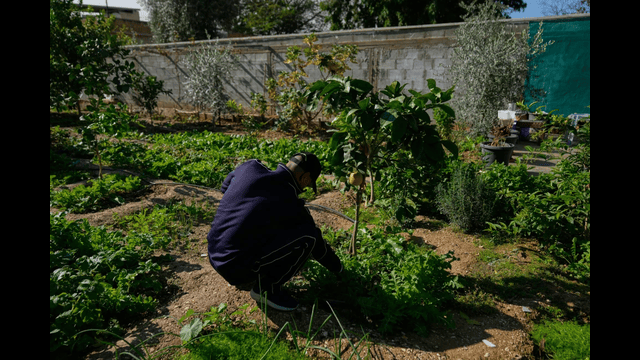
A Palestinian laborer who works inside a West Bank Israeli industrial zone maintains the garden at his house, in the West Bank city of Jericho, Saturday, Jan. 3, 2026.
Life has become a daily struggle for many Palestinians in the occupied West Bank.
The loss of access to jobs inside Israel has pushed thousands into poverty and uncertainty.
Families that once relied on steady wages now face eviction, hunger, and mounting debt.
Hanadi Abu Zant knows this reality too well.
She has not paid rent for nearly a year after losing her Israeli work permit.
When her landlord threatens police action, she hides inside a nearby mosque.
Her fear is simple and constant.
She worries about where her children will sleep if eviction comes.
For many Palestinians, that fear has become widespread and persistent.
Permits Revoked After Gaza War
The crisis intensified after the October 7, 2023, Hamas attack.
Israel responded by revoking work permits for about 100,000 Palestinians.
Most had been employed inside Israel before the war erupted.
Only a small fraction of those permits have since been restored.
Rights group Gisha estimates fewer than 10,000 were reinstated.
The majority remain confined to the West Bank, where jobs are scarce.
Israel says it has no obligation to grant entry permits.
Officials argue decisions are driven by security considerations.
They stress that permits can be revoked at any time.
Economy Near Breaking Point
The economic impact has been severe and far-reaching.
The World Bank warns the West Bank economy risks collapse.
Unemployment has surged to nearly 30 percent since the war began.
Before the conflict, joblessness stood closer to 12 percent.
Higher-paying jobs in Israel once sustained many households.
Those wages often doubled what workers could earn locally.
In 2022 alone, Palestinian wages from Israel totaled about $4 billion.
That figure equaled nearly two-thirds of the Palestinian Authority’s annual budget.
The loss has left a gaping hole in household and public finances.
Desperation Fuels Risky Choices
With legal work options limited, desperation has grown.
Some Palestinians sell belongings to afford food and electricity.
Others borrow heavily to cover school fees and medical costs.
A dangerous underground market has also expanded.
Brokers now charge triple the old price for work permits.
Many workers risk sneaking into Israel without authorization.
Crossing the separation barrier carries serious danger.
The barrier includes towering concrete walls and fortified roads.
Mistaken identity or arrest can lead to prison or worse.
Families Pay the Price
Shuhrat Barghouthi’s family illustrates the toll.
Her husband was jailed for trying to climb the barrier for work.
Before the war, their combined income supported the household comfortably.
Today, both parents are unemployed and deeply in debt.
Their refrigerator often sits empty.
Heating their apartment is no longer affordable.
Eviction threats loom constantly.
Sometimes, belongings are thrown into the street by landlords.
Children frequently go to bed hungry and unwell.
Settlements Remain an Exception
While access to Israel has tightened, settlements tell a different story.
More than 65 percent of Palestinians working in Israeli settlements kept permits.
These settlements are widely considered illegal under international law.
Palestinian workers describe harsher conditions inside settlements.
Employers have increased surveillance and tightened discipline.
Permits can be revoked without explanation or warning.
Some workers report phone searches by security guards.
Others fear speaking publicly due to retaliation risks.
Despite this, desperation keeps them reporting to work.
Impact Felt Inside Israel Too
Israeli businesses are also feeling the strain.
Palestinian labor once formed the backbone of construction and services.
Replacing them has proven costly and inefficient.
Foreign workers cost more and lack local language skills.
Many Palestinians speak fluent Hebrew alongside Arabic.
Developers say delays and rising costs are becoming common.
Some Israeli voices now call for a balanced solution.
They argue security and economic stability must coexist.
Without access to work, desperation will only deepen.
As conditions worsen, the West Bank work permits crisis continues to shape daily life.
For many families, employment is no longer about income.
It has become a matter of survival.