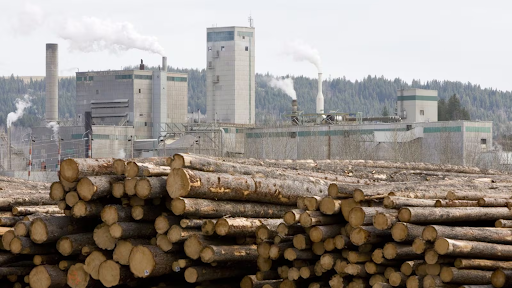
Logs are piled up at West Fraser Timber in Quesnel, B.C., on April 21, 2009.
West Fraser Timber Co. Ltd. will report a major financial adjustment in its fourth-quarter results.
The company plans to record a significant goodwill impairment linked to its lumber operations.
Management says persistent economic pressure has forced a reassessment of long-term expectations.
The Vancouver-based wood products producer expects the non-cash charge to total about $409 million.
This goodwill impairment reflects market realities rather than an immediate cash outflow.
Still, it signals deeper challenges across the North American lumber sector.
West Fraser Goodwill Impairment Tied to Economic Headwinds
West Fraser says the goodwill impairment stems from a prolonged industry downcycle.
Demand conditions have remained weaker for longer than initially projected.
As a result, management reviewed assumptions used to value its lumber segment.
Executives say those assumptions no longer matched current market behavior.
Revised projections now reflect slower recovery timelines and softer pricing trends.
These changes ultimately triggered the $409 million goodwill impairment charge.
Lumber Market Pressures Force Assumption Reset
The company highlighted several factors behind the impairment decision.
Lower demand for wood chip residuals played a significant role.
Pricing for these residual products has also declined across key markets.
West Fraser also adjusted expectations for the downturn’s duration and intensity.
Management now anticipates a longer and more severe cycle than previously forecast.
This reassessment reduced the estimated future value of certain assets.
Impact Concentrated in Lumber Segment
West Fraser clarified that the goodwill impairment is limited to its lumber business.
Other operating segments were not included in the charge.
The company continues to monitor broader market signals closely.
The impairment does not affect liquidity or near-term operating capacity.
However, it reflects a cautious outlook for lumber demand recovery.
Housing activity remains uneven across major North American regions.
Northern Alberta Mill Curtailment Adds Context
The goodwill impairment follows earlier operational decisions made by the company.
In December last year, West Fraser announced an indefinite curtailment at its northern Alberta mill.
The move was expected to impact about 190 employees.
At that time, West Fraser cited weakening oriented strand board demand.
Oriented strand board is widely used in residential construction projects.
It also supports repair, remodeling, and various industrial applications.
Construction Slowdown Continues to Weigh on Outlook
Demand for construction materials has remained under pressure.
Higher interest rates have slowed residential building activity.
Renovation spending has also softened in several key markets.
These trends continue to affect pricing power for wood-based products.
West Fraser says such conditions influenced its goodwill impairment assessment.
Management emphasized that market volatility remains elevated.
Strategic Focus Amid Challenging Cycle
Despite the impairment, West Fraser maintains a long-term strategic focus.
The company continues to prioritize cost control and operational flexibility.
Leadership says disciplined capital management remains a core objective.
West Fraser also reiterated its commitment to workforce safety and efficiency.
The company will adapt operations as market conditions evolve.
Future decisions will depend on demand visibility and pricing stability.
What the Goodwill Impairment Signals
The $409 million goodwill impairment underscores the severity of the downturn.
It reflects structural challenges rather than short-term disruptions.
Analysts often view such charges as resets during extended market cycles.
For West Fraser, the move aligns reported values with economic realities.
The company says transparency remains critical during uncertain conditions.
Investors will watch closely for signs of demand recovery ahead.