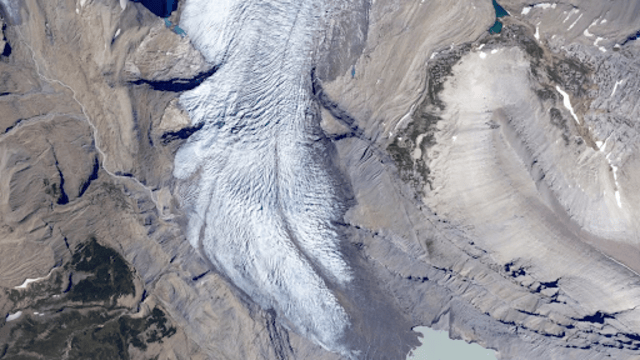
Robson Glacier appears in this photo shared by the Hakai Institute. A new research report reveals that glaciers across Western Canada and the United States (not including Alaska and Yukon) lost 12% of their ice between 2021 and 2024. The pace of melting has doubled during this period, highlighting growing concerns about rapid glacier loss. The Canadian Press
Western glaciers melting faster than ever
A new study reveals that glaciers in Western Canada and parts of the U.S. have lost 12% of their mass from 2021 to 2024. This is double the loss compared to the previous ten years. Scientists say this is part of a growing global trend of glacier shrinkage that shows no signs of slowing down.
Main causes of rapid melt
Researchers blame several factors. Low snowfall during winter and hot, dry weather in the early summer have played a big role. Heat waves arrived earlier than usual and stayed longer. These conditions melted more snow and ice than normal. Wildfires added to the problem. Smoke and ash from fires made glaciers darker. When ice is darker, it absorbs more heat and melts faster.
A dangerous feedback loop
Brian Menounos, a glacier expert and professor at the University of Northern British Columbia, explains that the melting creates a cycle. Once the surface darkens and melts, it becomes harder for snow to stick and build back. This makes the glacier lose even more ice in the future. “It’s like draining a bank account of fresh water and not adding anything back,” Menounos says.
Widespread impact beyond Canada
The study looked at glaciers in Canada, the U.S. (excluding Alaska), and Switzerland. All areas saw similar patterns of melting. Swiss glaciers lost 13% of their ice over the same three years. The glaciers lost ice at twice the speed they did from 2010 to 2020.
Past studies support the trend
The findings follow a 2021 study that showed the world’s glaciers were already losing ice faster than in earlier decades. This latest research confirms the trend is getting worse.
How the research was done
Scientists used both aerial and ground-based surveys. They tracked three glaciers in Western Canada, four in the U.S., and 20 in Switzerland. Between 2021 and 2024, these glaciers saw their highest melt rates since records began 60 years ago.
Wildfires making glaciers darker
The study highlights that black carbon levels – a sign of wildfire ash – have doubled since 2010. These reached their highest point in 2023 after a major wildfire season. Even though not all glaciers were tested for ash levels, researchers say any dark surface absorbs more heat and melts faster.
At Haig Glacier in the Canadian Rockies, ash and other dark materials caused 17% of the ice loss in 2022 and 2023. Hot summers caused nearly half of the total loss.
Need for better glacier models
Menounos says current models do not include wildfire ash or other fast-changing factors. He believes more accurate models are needed to understand how glaciers will change in the future.
Glaciers may vanish by 2100
The study warns that most glaciers in the studied areas may vanish by the end of this century, even if climate change slows down. Only the biggest glaciers and icefields might survive beyond 2100. In Europe, Swiss glaciers make up more than half the ice in the region. What happens there could show what lies ahead for the rest of the Alps.
From 2000 to 2023, Earth’s glaciers lost ice at a rate of 273 gigatonnes per year. This loss makes up about one-fifth of sea-level rise. One gigatonne equals a cubic kilometre of water.
Hope through action
Menounos says cutting greenhouse gas emissions could help. “To give the smallest glaciers a chance, we must act globally,” he says.