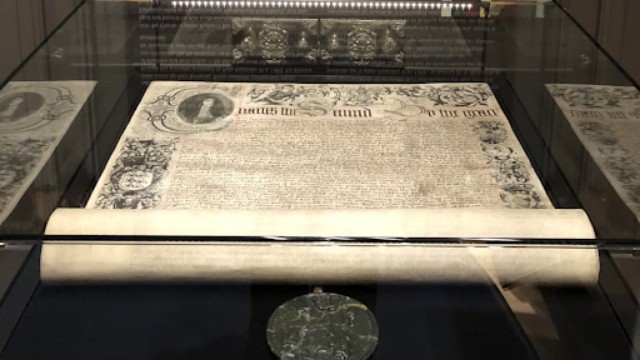
A historic 1670 royal charter signed by King Charles II, which established Hudson’s Bay, was loaned to the Manitoba Museum in 2020. It was displayed alongside the museum’s permanent collection of Hudson’s Bay artifacts. (Photo: The Canadian Press/Handout - Manitoba Museum. Mandatory Credit)
One of Canada’s oldest historical documents, the 355-year-old Hudson’s Bay Company Royal Charter, may soon be moving to a new permanent home—the Canadian Museum of History in Quebec. The Weston family, well-known for their retail empire, has expressed their intention to purchase the charter for $12.5 million and donate it to the museum.
Signed by King Charles II in 1670, the charter granted the Hudson’s Bay Company sweeping control over vast territories and influence over trade and Indigenous affairs in early Canada. It marked the beginning of one of the country’s most significant commercial empires and remains a powerful symbol of colonial history.
According to museum officials, the deal still needs court approval. But once approved, the charter will be immediately and permanently transferred to the museum by Wittington Investments Ltd., the family’s holding company. The Westons are also contributing an additional $1 million to ensure Indigenous groups are meaningfully consulted on how the document is displayed and interpreted.
Galen Weston Emphasizes Its National Value
Galen Weston stated in a press release that the charter is not just a piece of paper, but a reflection of Canada’s complex and evolving history. “At a time when Canada is facing serious challenges, it's important to preserve symbols that remind us who we are,” he said.
The family hopes to make the charter more accessible and transparent, especially to communities whose stories are directly tied to the document. The added funding is meant to support exhibits, cross-museum sharing, and collaborative discussions with Indigenous communities on how the charter should be understood today.
Charter’s Journey from Office to Museum
The Hudson’s Bay Company, which filed for creditor protection in March due to more than $1 billion in debt, had planned to auction off a large portion of its historical artifacts. The charter was originally listed among nearly 4,400 items set to be sold through a future partnership with Heffel Gallery.
However, the Bay decided to accept the Westons' offer, which significantly exceeded the charter’s appraised value. The offer also promised public access and support for Indigenous inclusion—two aspects that appealed to both the company and heritage groups.
Concerns Over the Privatization of Canadian History
Earlier this year, when news broke that Hudson’s Bay might sell its artifacts, heritage institutions and Indigenous leaders raised alarms. Many feared key pieces of Canadian and Indigenous history might disappear into private collections. Groups like the Assembly of Manitoba Chiefs voiced strong objections, calling for greater transparency and public access.
To ease concerns, Hudson’s Bay allowed select groups to review the inventory—under strict confidentiality. Items included paintings, vintage documents, point blankets, and even collectible Barbie dolls. But none sparked more public interest than the Royal Charter, which historians call the most treasured piece in the Bay’s collection.
What Experts Say About the Charter’s Importance
“This is clearly their crown jewel,” said Cody Groat, a Canadian historian and advisor to UNESCO’s Memory of the World Committee. He and others consider the charter one of the most critical documents in Canada’s colonial past.
Even private investors like Thomas Caldwell, CEO of Urbana Corp., previously expressed interest in acquiring the document for museum donation, admitting that private ownership of such an item would be difficult and expensive due to security and preservation needs.
The Hudson’s Bay Company had kept the document at its Toronto office for years, but recently moved it to a specialized storage facility. The charter was also temporarily on display at the Manitoba Museum in 2020, which currently holds the majority of the Bay’s historical items.
Kathleen Epp, curator of the Hudson’s Bay Company archives in Manitoba, said the charter naturally fits with their existing records. “We’ve got the rest of the story,” she said. “It makes sense for the charter to be here and made publicly available, just like the other documents.”