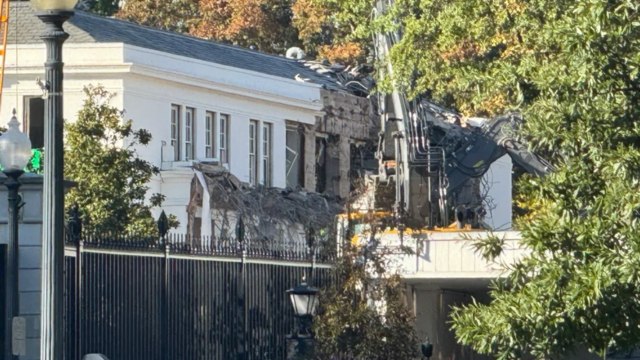
The White House’s East Wing as seen on Monday. BBC
Heavy construction equipment surrounded the White House’s East Wing on Monday as work began on a new $250 million ballroom project ordered by President Donald Trump. Crews tore down parts of the covered entryway and removed several windows, marking the start of one of the most significant changes to the building in decades.
Trump said the ballroom will “modernize” the White House while staying true to its historic look. “It won’t interfere with the current building. It’ll be near it but not touching it,” he said earlier this year. “It pays full respect to the existing building, which I love.”
A Grand Vision for the “People’s House”
The president announced the project on social media, calling it a “much-needed” addition. “For more than 150 years, every President has dreamt about having a ballroom at the White House,” he wrote, describing it as a space for state dinners and large celebrations.
The new structure will sit near the East Wing and is expected to host between 600 and 900 guests. Early design sketches show a lavish interior, featuring gold chandeliers and rows of formal seating.
Trump said the project is privately funded by “many generous patriots,” though the White House has not revealed who those donors are.
The East Wing, which dates back to 1902, was last renovated in 1942. The section now under demolition includes the area used for official ceremonies and events.
Questions Over Oversight and Process
The National Park Service (NPS), which manages the White House grounds, typically oversees any construction to ensure the building’s integrity and historical character. But several experts say this project appears to be moving forward without the usual review.
“There’s been controversy over any White House construction since the beginning,” said Robert K. Sutton, former chief historian of the NPS. “This building is one of the most important in the world, yet we don’t know what’s happening. That’s inappropriate.”
Sutton added that normally, the NPS would review blueprints, approve architects, and confirm costs before any major work began. He expressed concern that the project might reflect Trump’s personal style more than the building’s historical significance.
Architect Jim McCrery, whose firm is designing the addition, said he feels honoured to be part of the project. “President Trump has entrusted me to help preserve the elegance and importance of this historic home,” he said.
Critics Call for Transparency
Preservation groups have voiced strong objections to the demolition. The Society of Architectural Historians warned that the ballroom would be the first major change to the White House’s exterior in 83 years, urging a “rigorous and deliberate review process.”
The American Institute of Architects also called for more transparency. “Such a significant alteration to a historic building requires careful consideration,” the group said.
Following a Long Tradition of Change
Trump joins a long list of presidents who have altered the White House. Barack Obama turned the tennis court into a basketball venue. Richard Nixon converted the indoor pool into the Press Briefing Room, and Gerald Ford later added an outdoor pool. Harry Truman oversaw the building’s most extensive reconstruction between 1948 and 1952, when the White House was completely gutted and rebuilt.
Still, Trump’s ballroom will be the largest structural change since 1942 — one that blends history, politics, and controversy in a single project.